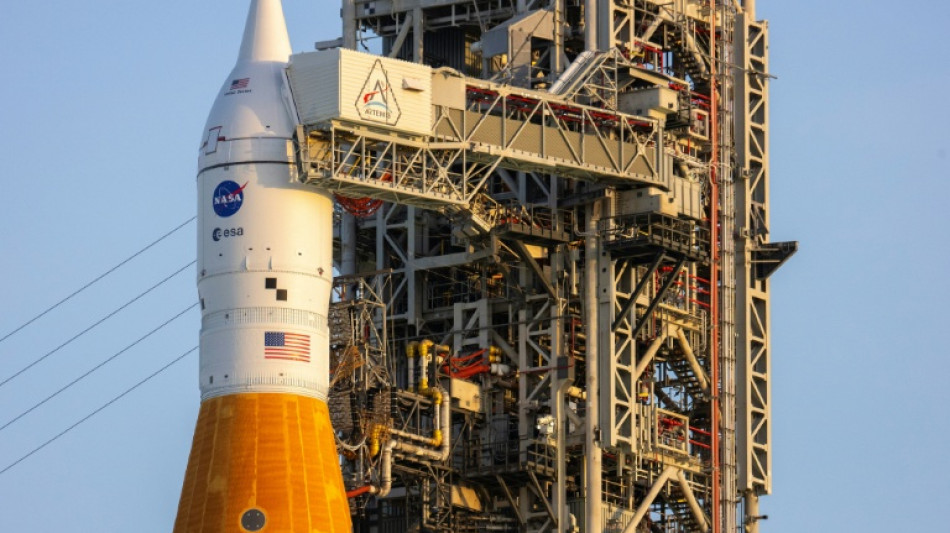
Florida tourists gather to 'witness history' ahead of Moon launch / Photo: Jim WATSON - AFP
Jason Heath had ventured with his family from northeastern Maine to the Sunshine State for a vacation -- but soon found out they were set to "witness history" with the launch of NASA's Artemis 2 mission.
"It's definitely cool to know that humans are going further than ever before," the 40-year-old shipbuilder told AFP from the shores of Cocoa Beach, a popular Florida resort area near the NASA launch complex from which the enormous orange-and-white rocket will blast off.
"It's definitely pretty cool to know that I'll be around," said Heath, his daughter and nephew clinging to his legs.
After several years of delays, the Artemis 2 mission is poised to carry three Americans and one Canadian on a journey that is expected to break the distance record set by the Apollo missions, venturing further into space than any crew has gone before.
The lunar mission -- the first of its kind in more than 50 years -- will see the first person of color, the first woman and the first non-American embark on a journey to the Moon.
According to local Florida newspapers, some 400,000 people are expected to turn up to watch liftoff, which is currently slated for Wednesday at 6:24 pm local time (2224 GMT).
- Fortuitous timing -
Temperatures were hovering around 77F (25C) as Alyx Coster, 38, enjoyed the beach with her children, who she says are "super excited" for the launch.
The family that includes a 10, 11 and 18-year-old had come into town from Minnesota for a baseball trip -- "we didn't know it was happening until we got down here," she told AFP.
But now they are now clued in to their fortuitous timing.
Coster said her children were "super proud that they'll get to witness history."
Their unawareness of the upcoming Moon launch is far from the exception: despite NASA's communication and subsequent news coverage emphasizing the historic nature of the flight, many Americans interviewed by AFP in recent weeks said they were unaware of the mission.
Melinda Schuerfranz, 76, remembers the Apollo days, when everyone would gather around the television to watch scientific advancement in action.
"I think it was way more exciting then, but I think it was publicized more too, and everybody tuned into it," the retiree from Ohio told AFP.
The "space race" with the Soviet Union also boosted interest, her husband John added.
But the couple enjoying their beach vacation were excited nonetheless: "We've never seen anything like this."
"We can't wait," said Melinda. "We'll be here early."
A.MacCodrum--NG