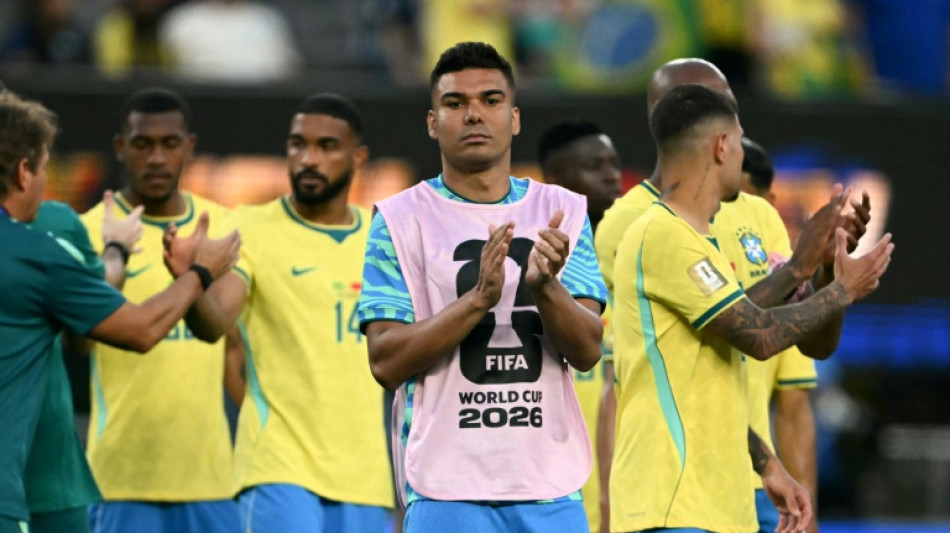
Brazil's frailties laid bare in shaky World Cup opener / Photo: Mauro PIMENTEL - AFP
Brazil's defensive frailties, lack of creativity and problems at full-back were exposed in a 1-1 draw with Morocco in their World Cup opener, raising doubts over their chances of lifting a sixth title.
Both Ancelotti and star forward Vinicius Junior, who scored the equaliser on Saturday, acknowledged the need for significant improvement if the Selecao are to lift the trophy for the first time since 2002.
Brazil teams of the past have arrived at previous tournaments not considered favourites and yet gone on to win the trophy, but the nature of their opening display gave little reason to suggest they will return to New Jersey for the final on July 19.
Despite the disappointing start against the 2022 semi-finalists, Ancelotti urged calm, pointing to the next match against minnows Haiti on June 19 as an opportunity to respond.
"We can't expect the team to be perfect from the get-go. You don't win a World Cup based on your first match," the Italian said.
However, the performance highlighted the shortcomings Brazil must address to go deep in the tournament.
Ancelotti had already admitted in March that Brazil no longer boast the attacking full-backs -- such as Carlos Alberto, Roberto Carlos or Cafu -- that once defined their play.
Roma right-back Wesley fits that profile but was ruled out with injury just before the tournament. That left Brazil with only two natural full-backs, Douglas Santos and Alex Sandro, both on the left.
On the right, Ancelotti has had to rely on Danilo, who plays at centre-back for Flamengo, as well as Bremer and Roger Ibanez, who offer a more defensive approach.
Ibanez started against Morocco but was replaced by Danilo at half-time.
"We have to adapt to the players available," said Vinicius.
- Midfield overrun and lacking spark -
Since Ancelotti took over a year ago, Brazil have conceded 12 goals in 13 matches, letting in at least one goal in each of their last six games.
Against Morocco, Brahim Diaz capitalised on Lucas Paqueta losing possession and a disorganised midfield to slice open Brazil's defence and set up Ismael Saibari for the opener.
The difficulties in midfield were more surprising, given one of Ancelotti's first moves as coach was to recall Casemiro last year after an 18-month absence.
Casemiro has enjoyed a solid farewell season at Manchester United, while Bruno Guimaraes has been key for Newcastle, but the pair could not match the intensity and energy of Morocco's midfield -- run by 18-year-old Ayyoub Bouaddi on his World Cup debut.
So dominant were Bouaddi and Neil El Aynaoui in the centre of the pitch that Ancelotti replaced five-time Champions League winner Casemiro at half-time.
"We could have controlled the game better," Casemiro said. "We lost the ball too often in midfield."
Brazil improved after the break with the introduction of ex-Liverpool midfielder Fabinho, though the shift was also in part due to Morocco fading as the physical toll of their aggressive pressing began to show.
A shortage of creative options in midfield, the absence of someone who can dictate play, is another grave concern for a nation that has produced some of the game's greatest playmakers.
Since the 2022 World Cup qualifying campaign, Brazil have relied heavily on Neymar, who is currently sidelined with injury and has struggled for form in recent years.
In his absence, playmaking duties have fallen to Paqueta, a responsibility that appears to weigh heavily on the former West Ham midfielder.
Vinicius stepped up at times on Saturday, but his primary role remains finishing, where he can best exploit his pace and dribbling.
"We should have created more," midfielder Fabinho said. "In the second half, with more intensity, we managed to create more chances and space."
Brazil will surely prove too strong for a Haiti side appearing at their first World Cup since 1974, but the five-time champions did anything but dispell the doubts about this current group of players against Morocco.
D.R.Megahan--NG