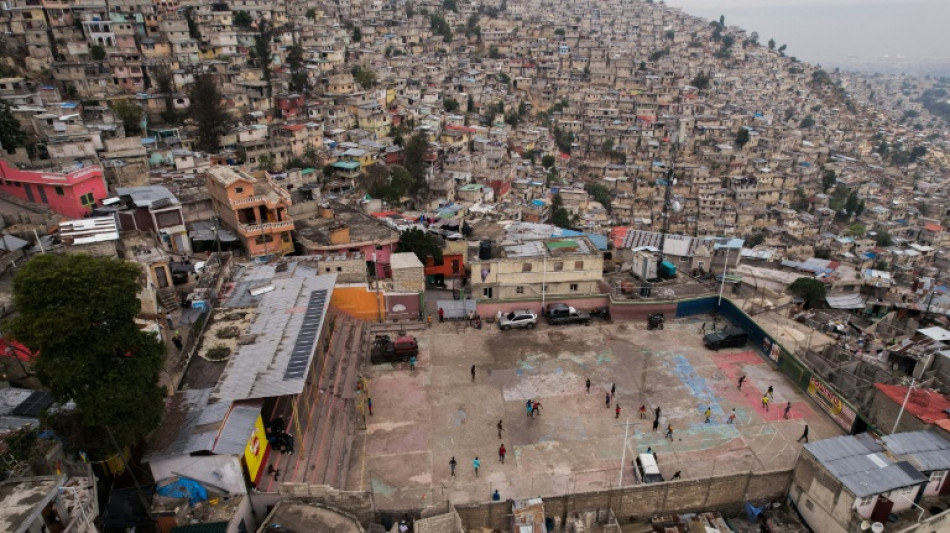
World Cup 2026: Haiti, a ravaged nation whose heart beats for football / Photo: Clarens SIFFROY - AFP
On a street in a suburb of Port-au-Prince, a dozen teenagers using stones for goalposts are immersed in a Sunday game of football as traffic winds around them.
Haiti has many problems, including political instability, poverty and crime. But through it all, the heart of the nation beats for football.
Haiti's qualification for this summer's World Cup has come like a breath of fresh air for the poorest nation in the Americas, whose nearly 12 million people have long grappled with gang violence that has caused a humanitarian crisis.
"Football is hope and love. It inspires pride and passion," said Salome Sandler Tally, founder and coach of the women's section of Aigle Noir AC, a professional club based in the Haitian capital.
"Qualifying for the World Cup is something special for a country that loves football so deeply."
The Grenadiers, as Haiti's team is known, made their only previous appearance in West Germany in 1974.
"It is incredible to have achieved this 52 years later," Tally told AFP.
- 'Pagan ceremonies' -
In early April, the cash-strapped government allocated 264 million gourdes ($2 million) for the national football team as a qualification bonus and to help pay for World Cup preparations.
Haiti will face Brazil, Morocco, and Scotland in Group C. Their games will be played in the United States, which is co-hosting the tournament with Mexico and Canada from June 11 to July 19.
In their World Cup qualifying campaign, Haiti did not play a single match on home soil.
The nation's main venue -- the Sylvio Cator Stadium -- has been closed since February 2024 as it is located in a Port-au-Prince neighborhood controlled by gangs, as is about 90 percent of the capital.
But the "beautiful game" is played everywhere by people who are barefoot, in flip-flops or in sneakers. They have matches on asphalt, dirt or worn-out artificial turf -- in neighborhood leagues, inter-school competitions, and tournaments involving both professional and amateur clubs.
Patrice Dumont, a former senator and sports columnist, said that in Haiti, a deeply religious nation, summer holiday leagues "are sites of pagan ceremonies that would make even the most devout fanatics blanche" -- an apparent reference to the charged atmosphere at the matches.
"You see them in every community -- provided there is space -- ranging from three-a-side matches to full 11-a-side games, always drawing massive crowds of spectators," he said.
Evens Lezin, a 49-year-old amateur player, said qualification for the World Cup will give "hope" to Haiti's youth.
"We can move forward, but it requires discipline," he said.
"Nowadays, many young people are delinquent. They struggle with alcohol, they smoke and they lack healthy recreational pursuits. But football can offer an escape."
- In every conversation -
The topic of football finds its way into every conversation. It bridges generational and social divides, and is talked about in restaurants, supermarkets, in living rooms and over the airwaves.
"Football is probably one of the few spaces for socialization still accessible to a large segment of the youth. It is the quintessential conversation starter," said football fan Marc Donald Orphee, 35.
Even though the majority of the men's and women's national team players play abroad, that has not diminished the public devotion's to the home side.
Pierreline Nazon, 18, a star of the women's under-20 team, compares herself to Melchie Dumornay, a Haitian midfielder for OL Lyonnes, a top French team.
Nazon spoke to AFP as she took time out from a training session in the hills above Petion-Ville, a suburb of the capital spared from violence.
"My dream has always been to play football -- to be like Melchie, and even to surpass her," she said.
"I know I will achieve this. That is why I keep training, seizing every opportunity to play, even though the situation in Haiti is difficult."
Ch.Hutcheson--NG