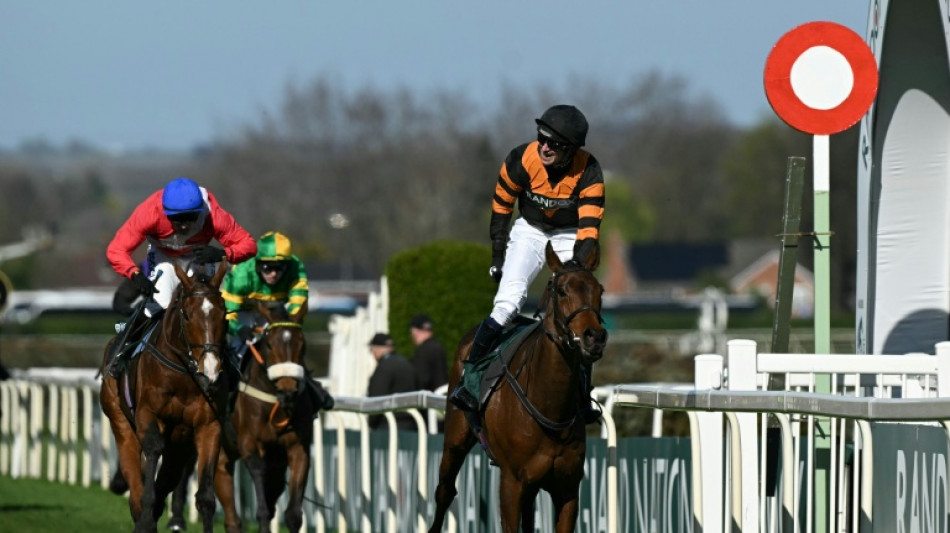
Grand National had to change to survive, says former winning jockey / Photo: Oli SCARFF - AFP/File
The Grand National is a radically different challenge than it was when Mick Fitzgerald rode Rough Quest to victory in 1996, but he told AFP you have "to evolve or you die".
The National, raced over four miles and with its 30 daunting fences, is a race that transcends horse racing, attracting once-a-year punters and a large global television audience.
However, there have been a series of modifications in recent years -- a reaction to animal welfare groups' concerns -- the latest in 2024.
These included shortening the run-up to the first fence and modifying several others, including one of the signature obstacles, Becher's Brook.
They also reduced the maximum number of runners from 40 to 34.
"If someone was to say we have to make these changes so the National can last 100 years then so be it," Fitzgerald told AFP by phone on Tuesday.
"One has to evolve or die -- to give a little so one can carry on."
Fitzgerald has bitter experience of how a fall in the National can have an impact.
Having experienced the greatest moment of a hugely successful career in 1996, he suffered serious spinal injuries in the 2008 edition which led to him retiring later that year.
The 55-year-old Irishman compared the changes to anti-smoking regulations, admitting "times have changed".
"It is like smoking," he said. "Back in the day one could smoke in pubs, planes and cinemas.
"If somebody said to you today 'Go ahead, smoke on the plane' you would reply 'You are kidding me'.
"Times have changed, as they have with the National.
"The risk has been reduced, but it was inevitable it would be, as people's attitudes have changed as to what is acceptable."
- 'Reality check' -
Fitzgerald, who also won a Cheltenham Gold Cup and Champion Chase, said the race still retains some of its aura.
"It is still a unique test," he said.
"I am not going to dress it up as still being the greatest race. though it is the greatest steeplechase, but it is not the same test it was 20-30 years ago.
"The fences are obviously not the same, the horses jump them differently.
"Most horses could get round these days whereas in the old days you needed a horse of a certain type to navigate the course."
Minutes after crossing the line on Rough Quest 30 years ago, when asked what it was like to win, Fitzgerald memorably said: "After that... even sex is an anticlimax!"
He still believes the jockey who wins on Saturday will occupy a status apart from his rivals.
"If someone who knows little about racing asks you what you do for a living and you reply 'jockey', they will ask you not about did you win a Gold Cup or a Derby but the Grand National," he said.
"It has a unique fascination for people.
"Absolutely it makes a difference to have that on your CV. Gives you a bit of kudos.
"You have succeeded where some of the legends of the sport fell short -- John Francome, Peter Scudamore and Jonjo O'Neill."
Jockeys will pay their annual visit to a children's hospital in Liverpool on the eve of the National.
"It is a reality check," said Fitzgerald, who is a patron of the hospital.
"It makes one realise galloping round a track does not matter, when you see the parents and their seriously ill children.
"You realise what is really important in life."
A.MacCodrum--NG