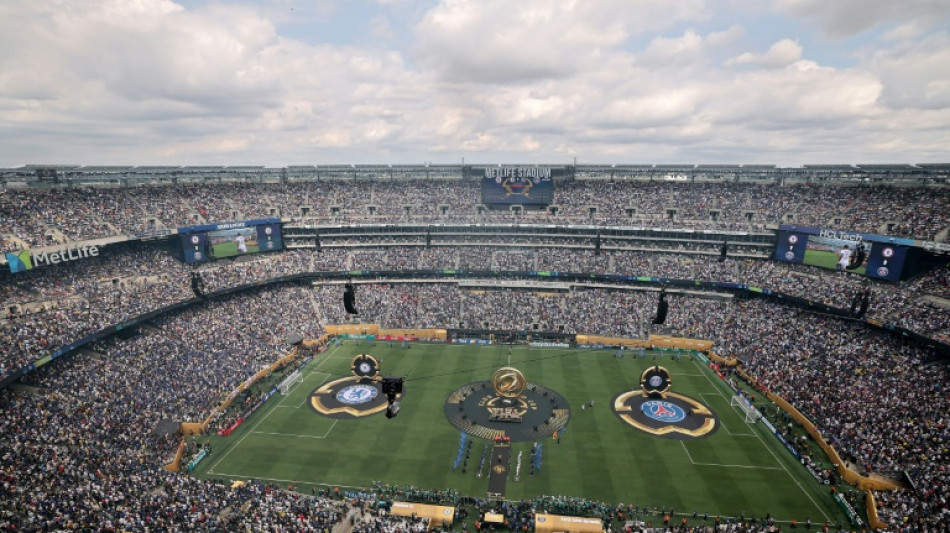
World Cup marks 100-day countdown amid political upheaval / Photo: Michael Reaves - GETTY IMAGES NORTH AMERICA/AFP
The 100-day countdown to the biggest World Cup in history gets under way on Tuesday against a chaotic backdrop of global unrest, from US-Israeli strikes on Iran to surging violence in Mexico and anxiety over Donald Trump's domestic agenda.
A record 48 teams -- up from 32 in 2022 -- and millions of fans are set to descend on the United States, Canada and Mexico for the first ever World Cup shared by three nations.
The greatest footballing show on earth kicks off on June 11 at Mexico City's Estadio Azteca and will conclude nearly six weeks later on July 19 at the 82,500-seater MetLife Stadium just outside New York.
A total of 104 matches will be played across 16 venues and four time zones, with the bulk of the action taking place in the United States, which will host 78 games.
FIFA President Gianni Infantino is confidently predicting a commercial bonanza from the tournament, which is expected to generate record revenues of $11 billion, comfortably eclipsing the $7 billion earned through the 2022 tournament in Qatar.
Infantino has repeatedly described the 2026 tournament's scale as equivalent to "104 Super Bowls", citing a global television audience in the billions and more than 508 million requests for some seven million tickets.
"The demand is there. Every match is sold out," Infantino said earlier this month.
Yet FIFA's revenues will also be boosted by a ticketing policy that is likely to price out many fans. Fan groups around the world, such as Football Supporters Europe, have accused FIFA of a "monumental betrayal" over pricing.
FIFA responded to those criticisms by introducing a tiny sliver of tickets priced at $60 for official supporters groups.
- Political football? -
Beyond the eye-popping numbers, the biggest challenges faced by the tournament may turn out to be political.
The Trump administration's domestic and international policies have triggered concerns about the smooth running of the tournament.
Trade wars which have included co-hosts Canada and Mexico, tensions with European allies over threats to annex Greenland and an immigration crackdown which may complicate travel to the United States for fans of some participating nations have all cast a shadow over the preparations.
Although calls for a boycott have failed to gather serious momentum, the build-up to the tournament continues to be dogged by swirling geopolitical uncertainty.
The US–Israeli strikes on Iran have provided the latest flashpoint, with Iran's team due to play its three group games in Los Angeles and Seattle.
The Trump administration's immigration crackdown meanwhile has seen enhanced visa restrictions on dozens of countries including four World Cup qualified nations -- Iran, Haiti, Senegal and Ivory Coast.
The White House insists this will not affect tourist visas and therefore fans who have tickets, who can benefit from expedited visa appointments.
Another logistical headache has unfolded in Mexico, where the recent killing of one of the country's most notorious drug lords in a military operation sparked a wave of unrest.
The surging violence gripped Guadalajara, Mexico's second biggest city, which is hosting four World Cup matches.
Both Infantino and Mexican President Claudia Sheinbaum have both given assurances that the recent unrest will not disrupt World Cup games taking place in the country.
"Very reassured, everything's good," Infantino told AFP at a meeting in Colombia last week when asked how the violence might impact Mexico's World Cup planning.
- Messi swansong -
On the field, meanwhile, the tournament itself faces its own challenges.
The expanded 48-team format means that the initial group phase is likely to be stripped of jeopardy.
The top two teams from each of the 12 first round groups, plus the eight best third-placed teams will qualify for the first round of the knockout phase, making it highly unlikely than any of the tournament's traditional big guns will be eliminated at the first hurdle.
When the action does get under way, all eyes will be on defending champions Argentina, who will be spearheaded once more by Lionel Messi, who will celebrate his 39th birthday on June 24, during what is the sixth -- and almost certainly last -- World Cup of his career.
Argentina's hopes of winning back-to-back World Cup titles will face a stern challenge from 2018 champions France and reigning European champions Spain.
England, coached by Germany's Thomas Tuchel, meanwhile will once again attempt to end the country's 60-year wait for a major tournament victory.
At the other end of the spectrum of contenders will be a handful of teams playing in the World Cup for the first time, including Cape Verde, Curacao, Jordan and Uzbekistan.
burs/rcw/mw
Y.Byrne--NG