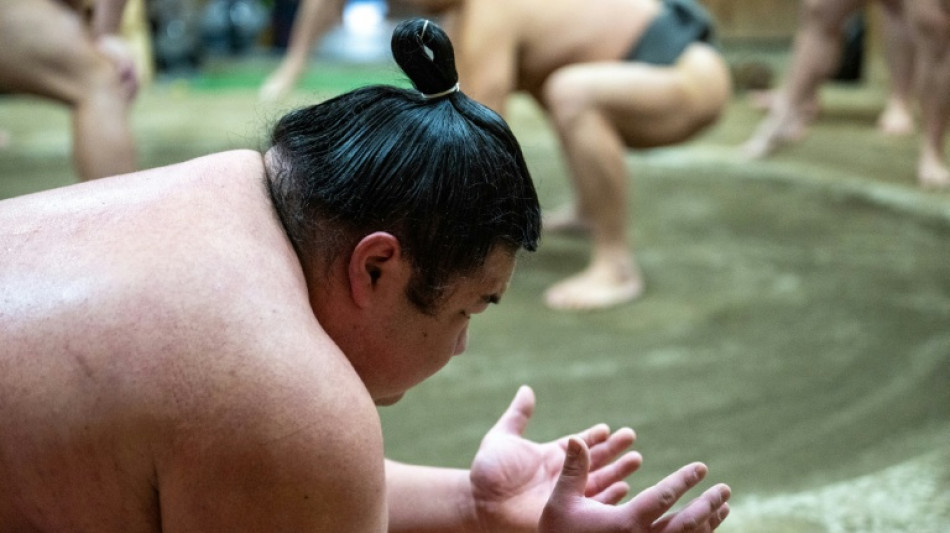
Sumo diplomacy: Japan's heavyweight 'soft power' ambassadors / Photo: Mathias CENA - AFP
Two giants stare each other down before colliding with a dull thud. After years on the sidelines, sumo is back centre stage as part of Japan's soft power arsenal overseas.
Behind the scenes at the New Year Grand Sumo Tournament that ended Sunday in Tokyo, preparations were already being made for a tour of Paris in June, following a stop in London last year.
The last time sumo wrestlers travelled to France was in 1995, when such tours were common, but they have become something of a rarity in recent years.
Before last year's visit to London's Royal Albert Hall, the previous time the Japan Sumo Association (JSA) held a tournament overseas was in Las Vegas in 2005.
Using the hulking wrestlers as ambassadors is a long-established practice.
As early as 1854, they displayed their strength before Commodore Matthew Perry, sent by the United States to secure Japan's diplomatic and commercial opening after two centuries of isolation.
In his journal, Perry described the performance as "barbaric", performed by wrestlers "more like bulls than humans".
Perry "observed everything about Japan from a position of almost total ignorance of the country", said Jessamyn R. Abel, professor of Asian studies at Penn State University.
Today, by contrast, "for a spectator who already thinks Japan is 'cool', sumo just reinforces" that idea, she added.
- Sumo vs. pandas -
Japan has understood this well, says Kosuke Takata, associate professor at Waseda University's School of Sport Sciences.
"Government agencies for sport and tourism are seeking to promote 'martial arts tourism', not only sumo, but also kendo and karate," he said.
Such tours continued throughout the 20th century in the United States, Europe, the Soviet Union and China, complementing Japanese diplomacy during the Cold War.
In 1973, wrestlers travelled to Beijing to celebrate the previous year's establishment of diplomatic relations between Japan and Mao Zedong's China.
China, in turn, exercised its "panda diplomacy" by sending two bears to Tokyo.
With relations now at a low point -- Japan's last two pandas returned to China on Tuesday -- a sumo tour would no longer have the same impact, says Erik Esselstrom, professor of history at the University of Vermont.
At the time, China "was relatively weak and Japan quite strong" economically, and the two countries were "in a moment of rediscovery", he said.
Overseas trips became rare over the past two decades as the sumo association refocused on its domestic audiences while the sport's popularity waned, partly due to a series of scandals.
The Covid-19 pandemic then prevented travel abroad.
Yasutoshi Nakadachi, a former wrestler and organiser of the Paris trip, said the JSA was in a "complicated situation", and also had a lack of interest from foreign countries.
- 'Not entertainment' -
The context is now very different, with Japan welcoming a record number of tourists in 2025.
Overseas visitors are increasingly eager to see sumo, and tournaments in Japan are regularly sold out.
David Rothschild, promoter of the Paris tournament, recalled approaching the sumo association about 10 years ago but receiving no response until 2023.
"And then, after many exchanges, everything sped up: in a month we had practically done everything," he said.
The JSA's requirement? "Sumo must always be considered a tradition. It's not just a sport and it's not entertainment," Rothschild said.
"In every discussion they wanted to make sure I wouldn't do anything inappropriate, that I would be respectful."
Paris has already hosted the wrestlers twice, in 1986 and 1995, and officials from the sumo association remember the trip as wrestlers themselves at the time.
"We fought seriously but otherwise we were mostly happy to enjoy Paris," said Nakadachi.
Sumo official and former wrestler Sehei Kise says he was struck by meeting France's then-president Jacques Chirac, who was a great fan of sumo.
Current wrestler Wakamotoharu, a cinema enthusiast, hopes to take advantage of the trip to visit Place de la Concorde, where a scene from the film "The Devil Wears Prada" was shot.
Once on the Parisian cobblestones, he could well become the real attraction.
O.F.MacGillivray--NG