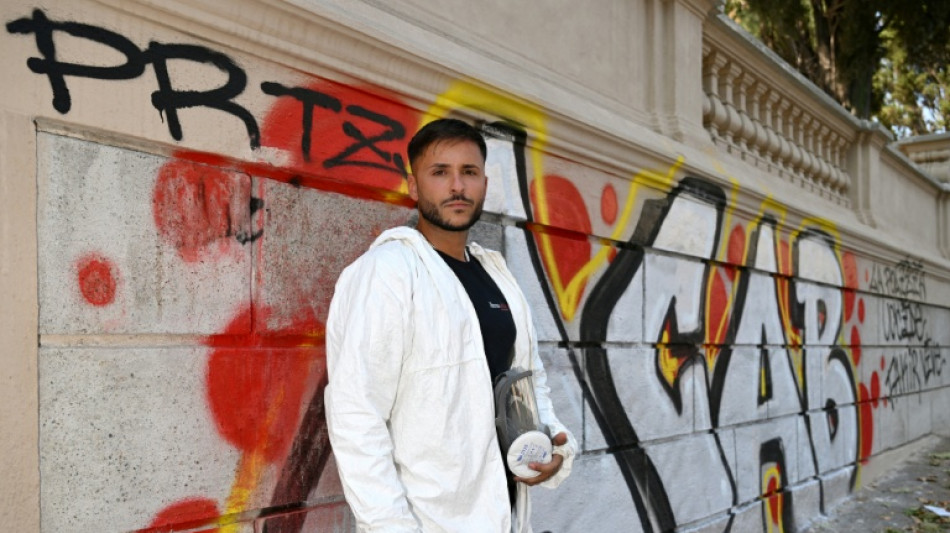
In Rome, one man's crusade against graffiti / Photo: Alberto PIZZOLI - AFP
Inch by inch, the high-pressure jet erased the huge, gaudy tag -- the second time in two weeks that Valerio Tuveri has sandblasted clean the wall of a historic park in Rome.
Wearing a full white overall, headphones over his ears and a work mask protecting his face, Tuveri and his helper patiently blasted the tag that appeared a few days ago.
"ACAB" -- the acronym for an anti-police slogan -- was scrawled in large white letters on the wall of the newly-renovated Villa Sciarra public garden, near the leafy Trastevere neighbourhood.
"Today we’re here for the second time," Tuveri told AFP, as he worked on the wall around the park that includes the historic Villa Sciarra.
He attributed the tag to activists protesting the recent death during an arrest of a Moroccan man, Abderrahim Fakir, which sparked outrage across the country.
The 28-year-old Tuveri -- known on Instagram and TikTok as "the guy who cleans Rome," with the handle “mr.tuvs” -- has been posting videos for two years showing off his graffiti-cleaning, which he carries out for free in agreement with city authorities.
When he started posting on social media in mid-2024, he was working for a private company specializing in cleaning and restoring monuments, statues and fountains.
He calculates that he cleaned about eight kilometres (five miles) of walls -- "all the embankment walls along the banks of the Tiber" -- ahead of the Vatican's 2025 Jubilee, a holy year that drew millions to Rome.
That is when the idea came to him to keep cleaning -- on his own time.
Since then, Tuveri -- who has more than 80,000 followers on Instagram -- has inspired imitators, notably in the northern city of Brescia, but also abroad, especially in Brazil and Spain.
- Changing attitudes -
Since Tuveri started posting videos, he has noticed attitudes changing about Rome's ubiquitous tags.
Before people considered them "normal," he said.
"But when they saw the beauty that lies behind a wall that's been cleaned of graffiti" they began to consider tagging "despicable", he said.
A tour guide who lives near the park, 26-year-old Emilia Del Monte, told AFP that most of the tags she sees have "no artistic meaning whatsoever".
"Creating a mural is one thing," but damaging public property "is something else entirely," she said.
Tourists frequently ask her why there is so much graffiti in the city. "It's almost become a distinctive feature of the neighbourhood," she said.
For Tuveri, the paint sprayed on Rome monuments, apartment buildings, store-front shutters, garbage dumpsters and trains has worsened in recent years, notably due to a lack of dissuasive sanctions.
He believes there should be "steep fines and cameras, lots of cameras,” on top of awareness campaigns.
According to Rome police, between January and early July, about 50 people were sanctioned for the misdemeanours of damage and destruction of buildings.
Asked for comment, Rome's city councillor for environmental policy and citizen relations, Stefano Marin, said that "volunteering cannot and must not permanently replace the responsibilities of institutions".
Marin said that Rome has only limited financial resources, however, "compared to the size of the territory and the frequency of acts of vandalism".
In addition to installing security cameras in the most affected areas, he proposes a national tax credit to offset expenses incurred by citizens, associations or businesses that help restore urban spaces.
Marin pointed to cities like Paris and London, where authorities work closely with police and community groups after receiving graffiti alerts.
Tuveri said he could justify graffiti if it brought "art to something that doesn’t have any".
"But if Rome is already art, it makes no sense.”
O.F.MacGillivray--NG