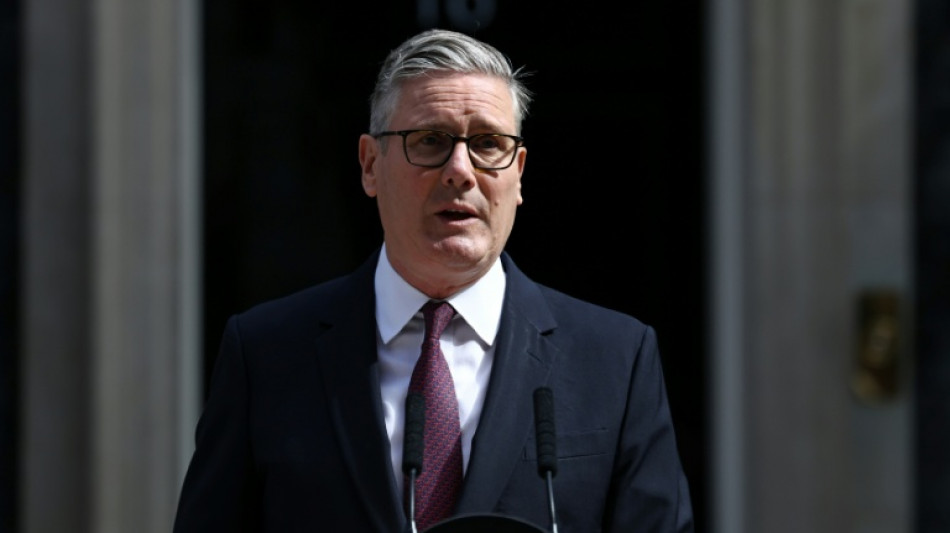
UK's Starmer resigns as prime minister / Photo: Henry NICHOLLS - AFP
UK leader Keir Starmer announced his resignation on Monday following months of pressure, kickstarting a process that will see Britain get its seventh prime minister in a decade.
In a speech outside 10 Downing Street, Starmer -- in office since July 2024 -- conceded he had lost the support of his Labour party MPs.
He said he had informed King Charles III of his decision to resign so that a new Labour leader, and therefore prime minister, could be elected.
"I will remain in post as prime minister until the contest is complete, and I will do everything I can to ensure an orderly handover of power," he said.
Starmer's authority has been waning since Labour endured a drubbing in local and regional elections in May.
He was unable to withstand the pressure any further following confirmation last week that his rival Andy Burnham was returning to parliament, clearing the path for an anticipated leadership challenge.
Burnham, a veteran Labour politician, is due to take up his seat in the House of Commons later on Monday after winning a parliamentary by-election in Makerfield, northwest England, on Thursday.
"The question my party is asking now is whether I am best placed to lead us into the next general election," Starmer said, as senior ministerial colleagues looked on.
"I have heard the answer of my parliamentary party to that question, and I accept that answer with good grace.
"Every decision I have taken has been about putting the country I love first. That is why I will resign as leader of the Labour Party," he added, choking up in an emotional speech.
Starmer said he had asked Labour's National Executive Committee to set out a timetable for his replacement, with nominations due to open on 9 July.
"This will ensure that a new leader is in place before parliament returns in September" after the summer recess, he explained.
Attention now turns to whether Burnham will become leader without a contest, as many Labour MPs have called for, or whether another candidate such as ex-health minister Wes Streeting decides to run as well.
Under Labour's rules, the leader of the centre-left party must be a member of parliament.
- 'Final chance' -
While Starmer had insisted he would fight any attempt to oust him, the emphatic nature of Burnham's victory last week and subsequent pressure was too much to withstand.
Foreign Secretary Yvette Cooper and energy minister Ed Miliband were among the senior ministers telling her boss to go, according to the press, while more than 100 of Labour's 403 MPs have reportedly urged him to resign.
Burnham -- who became the mayor of Greater Manchester mayor in 2017 -- has made clear he intends to bid to lead Labour, warning in his by-election victory speech the slumping ruling party had a "final chance to change".
If successful, the 56-year-old is set to replace Starmer as prime minister thanks to Labour's huge parliamentary majority.
Nigel Farage, the leader of the hard-right, anti-immigration Reform UK party, was swift to call for snap elections. His party has been leading the polls in national surveys.
Starmer, who polls show is deeply unpopular with the public, reportedly spent the weekend holed up with his family at Chequers, the countryside retreat for prime ministers, holding talks with allies.
He has been clinging to power for months after a tenure littered with missteps, policy U-turns, scandals and ministerial resignations.
Starmer was nearly ousted in March over his ill-fated decision to appoint Peter Mandelson, a known associate of the late US sex offender Jeffrey Epstein, as the UK's ambassador to Washington.
A former MP and government minister in the 2000s, Burnham defied national trends by easily beating the hard-right, populist Reform UK party's candidate.
UK media say he intends to replace finance minister Rachel Reeves, while retaining interior minister Shabana Mahmood.
J.Fletcher--NG