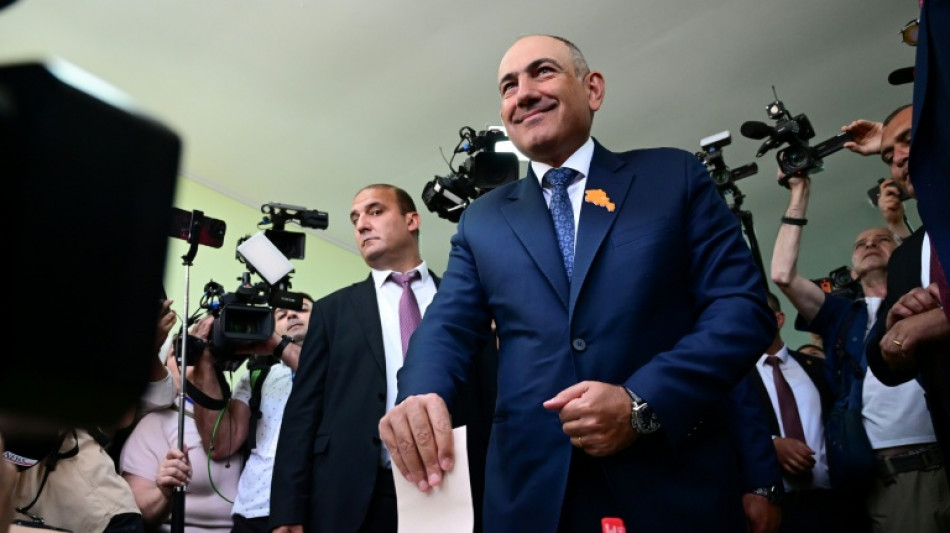
Armenia PM heads for win to cement Westward shift / Photo: Karen MINASYAN - AFP
Armenian Prime Minister Nikol Pashinyan's party led the opposition Monday in early results from parliamentary elections that could cement his Westward tilt, after threats from Moscow and claims of Russian interference.
Armenia and Russia are technically allies, but Moscow has compared the former Soviet republic's ambitions to join the European Union to the path it claims triggered its 2022 invasion of Ukraine.
Early results showed the ruling Civil Contract party leading Russian-Armenian billionaire Samvel Karapetyan's Strong Armenia alliance by 52.5 to 23.2 percent, with 23.5 percent of electoral precincts reporting, the Central Election Commission said.
Two other opposition forces -- ex-president Robert Kocharyan's "Armenia" alliance and the Prosperous Armenia party -- also cleared the electoral threshold, winning 9.3 percent and 4.6 percent of the vote respectively.
Turnout was 59 percent, the commission said.
Pashinyan hailed his party's "historic victory that will ensure Armenia's eternity and development."
"Civil Contract has won and will form the government," he told a press conference.
The election comes after years of upheaval since Pashinyan was propelled to power in a 2018 street revolution.
The small Caucasus country is still reeling from long-time foe Azerbaijan's military takeover of the Karabakh region.
The conflict came to an end in 2023, when Azerbaijan's army seized control of the enclave, and most of the Armenian population fled.
Pashinyan has framed the vote as a choice between a lasting peace with Azerbaijan, or a return to war.
The 51-year-old has also sought to loosen Armenia's dependence on Moscow, after it failed to help during the Karabakh conflict.
While US President Donald Trump offered his "TOTAL Endorsement for Re-Election" to "great friend and Leader" Pashinyan, Moscow has bristled at the possible loss of yet another ally in its backyard.
"We will accept any choice made by the people," Pashinyan told journalists at a polling station in Yerevan after casting his ballot.
He pledged Armenia would pursue a balanced foreign policy after the vote, insisting "there is no question of choosing" between Russia and the West.
The Kremlin has been accused of seeking to sway the vote.
Analysts have noted misinformation on the web, hacker activity and Kremlin-friendly narratives portraying Western cooperation as dangerous.
In the weeks before the vote, Russia banned the import of several products from Armenia -- seen as a move to heap economic pressure on the country.
And Armenian officials have warned "enemies of freedom" are funding propaganda efforts.
- 'Reckless rush' -
Pashinyan has insisted he does not want a rupture with Moscow.
But the campaign played out as a battle over Armenia's geopolitical future.
Pashinyan and his chief opponents all accused each other of risking a fresh conflict.
Pashinyan told voters Armenia could face a "catastrophic war" with Azerbaijan within months if his party failed to secure a strong majority.
His opponents called that rhetoric fear mongering.
Opposition parties accused the authorities of electoral violations and repression, particularly against their campaign staff.
Armenia's Investigative Committee said it had opened 59 criminal cases over alleged electoral violations -- including multiple voting -- and detained nine people.
Strong Armenia's leader Karapetyan has rejected claims he would drag Armenia back into Russia's orbit, but warned against Pashinyan's "reckless rush" to the West.
He has been under house arrest since last year on charges of plotting a coup -- allegations he rejects as politically motivated.
- 'Voted for peace' -
Pashinyan's democratic record was also on the ballot paper.
Eight years after he swept to power on a promise to dismantle Armenia's oligarchic system, he faces increasing accusations of democratic backsliding.
Still, for many Armenians, the opposition remains associated with Russian influence and oligarchs.
"I voted for peace. Only Pashinyan can bring peace," one voter, 63-year-old craftsman Hakob Hakobyan, told AFP.
Another voter, Khachatur Movsisyan, a 59-year-old mechanical engineer, said he had backed an opposition party "because the country, and all of us, need change -- in foreign policy, domestic policy and in negotiations with Azerbaijan".
X.Fitzpatrick--NG