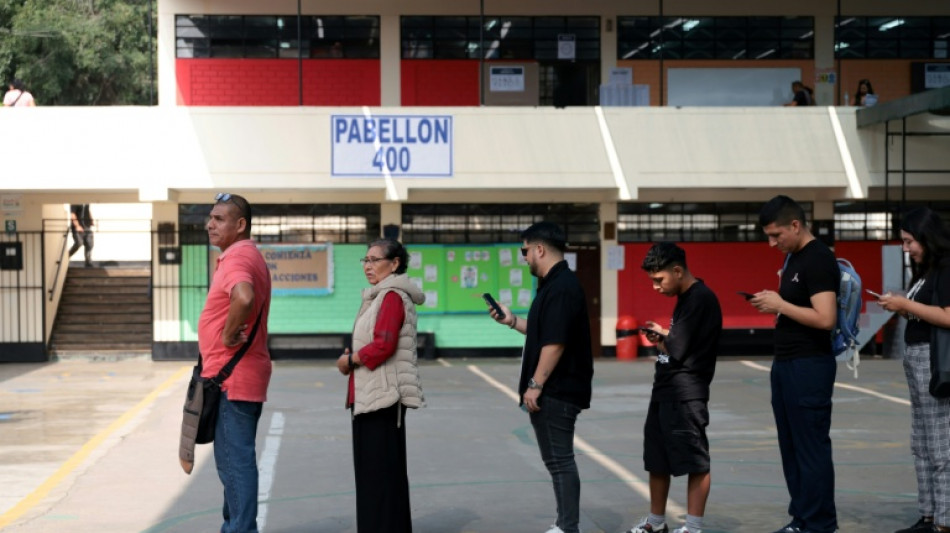
Delays mar vote as crisis-hit Peru picks ninth president in decade / Photo: Connie FRANCE - AFP
Hours-long delays marred Peru's presidential and legislative elections on Sunday, as voters sought to end political chaos that has seen a string of presidents ousted or jailed.
From the Amazon to the Andes, around 27 million Peruvians voted on half-metre-long ballots listing 35 presidential candidates, in a contest dominated by concerns about crime and corruption.
Peru has had eight presidents in the last decade, with impeachment and corruption convictions so common the country even built a jail for former leaders.
The frontrunners in the race include a conservative comedian, an autocrat's daughter, and an ex-mayor who likens himself to a cartoon pig.
Conservative candidates have dominated pre-election polls, raising the prospect Peru could join the growing tide of hard-right leaders in Latin America.
"I want people to vote for an honest president," said shopkeeper Anita Medrano, 60. "Not the old or traditional ones. They already had their chance."
No candidate was polling above 15 percent, well short of the 50 percent needed to win outright, making a June runoff likely.
"The people can't take it anymore," said Rosenda Lopez, a 47-year-old textile vendor. "I hope someone is elected who works for the community. They are killing us."
Delays of several hours in opening some polling centers sparked cries of fraud after a bitter campaign.
Furious would-be voters waited for seven hours under the equatorial sun in parts of Lima.
The electoral commission blamed a subcontractor for failing to deliver materials and extended voting by an hour.
- Crime and punishment -
In the past decade, Peru's homicide rate has more than doubled, while reported extortion cases jumped from about 3,200 to 26,500 a year.
In response, candidates have competed with hardline pledges, including killing hitmen, deporting migrants and locking criminals in jungle prisons ringed with snakes.
"We have to end this," said voter Elena Flores, 50. "We are living in a country of drug traffickers."
On the eve of the vote, frontrunner Keiko Fujimori told AFP she would "restore order" in her first 100 days by sending the army into prisons, deporting undocumented migrants and strengthening borders.
In an exclusive interview Fujimori said she would seek a united front with conservative leaders in the United States, Argentina, Chile, Ecuador and Bolivia.
"We will ask for special powers," she said, including to modernize police and deploy the armed forces in prisons. "We will expel undocumented citizens."
This is Fujimori's fourth bid for the presidency. Her father, former president Alberto Fujimori, died in 2024 after serving 16 years in prison for crimes against humanity, bribery and embezzlement.
During the campaign, she has leaned on renewed nostalgia for his strongman rule.
"I believe that time and history are giving my father the place he deserves," she said.
She faces a late surge from former Lima mayor Ricardo Belmont, 80, who has built a large following on TikTok.
"He's collecting votes from left to right, like Pac-Man," said Patricia Zarate of the Institute of Peruvian Studies.
Also running are TV comedian Carlos Alvarez and far-right ex-mayor Rafael Lopez Aliaga, who has promised to "hunt" Venezuelan migrants and calls himself "Porky" after the cartoon character.
Sociologist David Sulmont said the election showed "a major disconnect" between voters and what politicians are offering.
Incumbent president Jose Maria Balcazar, in office for less than two months, is barred from running.
Polling stations opened at 7:00 am and will close at 6:00 pm local time (2300 GMT), an hour later than planned. Voting is compulsory.
P.MacNair--NG