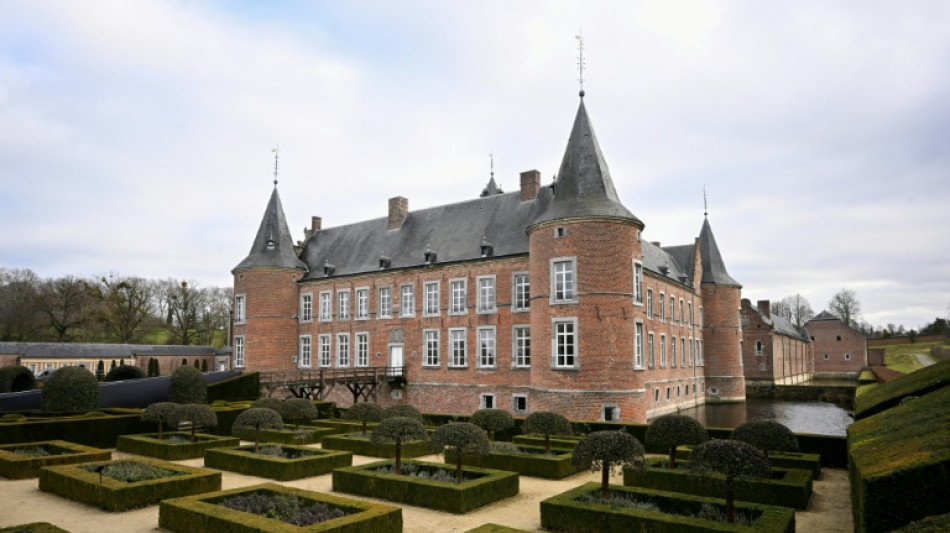
EU vows swift reforms to confront challenge from China, US / Photo: JOHN THYS - AFP
EU leaders Thursday vowed to act boldly to bolster Europe's economy faced with twin threats from China and the United States, as they huddled in a Belgian castle to bridge differences on the path ahead.
It is a challenge that has long dogged the European Union, but has gained greater urgency because of geopolitical shocks, intensified global competition and an economy that lags behind bigger powers.
Leaders share a common diagnosis that Europe's moribund economy needs a kickstart -- but they are far from agreed on the cure.
Paris and Berlin have publicly diverged on France's push to favour EU companies and for more joint debt -- although French President Emmanuel Macron and German Chancellor Friedrich Merz were keen to present a united front on Thursday.
"We share this sense of urgency that our Europe must act very clearly" in the face of "very strong pressure", such as unfair competition from China and US tariffs, Macron said.
"We want to make this European Union faster. We want to make it better," Merz said, adding: "I am pleased Emmanuel Macron and I are almost always in agreement on these matters."
The "Buy European" push will likely be the source of tough debate during Thursday's talks as many states including Sweden and the Netherlands -- proponents of free trade -- caution against veering into protectionism.
Merz said on Wednesday that such a move should be used as a "last resort".
- Unlocking private investment -
Billed as a "strategic brainstorming," Thursday's meeting is not expected to produce immediate action.
On the menu of talks at the 16th century Alden Biesen castle will be how to unlock private investment to ramp up competitivity, European Council President Antonia Costa told reporters -- with no mention of joint debt.
Unlike their American rivals, European companies face challenges accessing capital to scale up despite the fact that Europe is home to some of the world's biggest economies including Germany and France.
"We have a clear priority to strengthen economic growth in Europe that is essential to our prosperity," Costa said before talks began.
The EU's list of concerns is long including lacklustre economic growth compared with China and the United States, and dependencies on countries outside the bloc including China for rare earths essential for industry.
Italian Prime Minister Giorgia Meloni expressed concern over energy prices -- higher than in most industrialised economies -- which European businesses say also makes it difficult to catch up with foreign rivals.
Leaders, backed by influential European figures, believe the key to transforming the 27-country bloc's economy is to deepen the single market and make it easier for businesses to work across the continent.
They will hear from ex-European Central Bank chief, Mario Draghi, author of a landmark report published 18 months ago that has guided EU efforts to be more competitive.
- Two-speed Europe -
Draghi's report will not be the only report leaders will be leaning on.
After Draghi addresses leaders in the morning, they will then hear from Italian ex-premier Enrico Letta, who has called for deeper integration, including a savings and investments union to help companies access capital.
This has been a longstanding wish and will be harder to achieve in the short term. Therefore the EU wants to move forward by "simplifying" EU rules to reduce the administrative burden for businesses and striking more trade deals.
European Commission President Ursula von der Leyen has raised the possibility of what she calls "enhanced cooperation", which would mean EU states that want to can move forward on certain reforms if the 27 states can't agree.
The EU executive also believes creating a new legal system for businesses outside of the scope of member states -- the so-called 28th regime -- would make it easier for companies to work across the bloc.
W.Prendergast--NG