Trump pulls US out of key climate treaty, deepening global pullback / Photo: TIMOTHY A. CLARY - AFP/File
President Donald Trump is withdrawing the United States from a foundational climate treaty as part of a sweeping exit from collective global action, the White House announced Wednesday.
A total of 66 global organizations and treaties -- roughly half affiliated with the United Nations -- were listed in a White House memorandum as "contrary to the interests of the United States."
Most notable among them is the United Nations Framework Convention on Climate Change (UNFCCC), the parent treaty underpinning all major international climate agreements.
Trump, who has thrown the full weight of his domestic policy behind fossil fuels, has openly scorned the scientific consensus that human activity is warming the planet, deriding climate science as a "hoax."
The UNFCCC was adopted at the Rio Earth Summit in June 1992 and approved later that year by the US Senate during George H.W. Bush's presidency.
The US Constitution allows presidents to enter treaties "provided two thirds of Senators present concur," but it is silent on the process for withdrawing from them -- a legal ambiguity that could invite court challenges.
Trump has already withdrawn from the landmark Paris climate accord since returning to office, just as he did during his first term from 2017–2021 in a move later reversed by his successor, Democratic president Joe Biden.
Exiting the underlying treaty could introduce additional legal uncertainty around any future US effort to rejoin.
But Jean Su, a senior attorney for the nonprofit Center for Biological Diversity, told AFP: "Pulling out of the UNFCCC is a whole order of magnitude different from pulling out of the Paris Agreement."
"It's our contention that it's illegal for the President to unilaterally pull out of a treaty that required two thirds of the Senate vote," she continued. "We are looking at legal options to pursue that line of argument."
"The US withdrawal from the UN climate framework is a heavy blow to global climate action, fracturing hard-won consensus," Li Shuo of the Asia Society Policy Institute told AFP.
- 'Progressive ideology' -
Rachel Cleetus of the Union of Concerned Scientists called the decision a "new low and yet another sign that this authoritarian, anti-science administration is determined to sacrifice people's well-being and destabilize global cooperation."
The memo also directs the United States to withdraw from the Intergovernmental Panel on Climate Change, the UN body responsible for assessing climate science, alongside other climate-related organizations including the International Renewable Energy Agency, UN Oceans and UN Water.
As in his first term, Trump has also withdrawn the United States from the Paris Agreement and from UNESCO -- the UN Educational, Scientific and Cultural Organization -- which Washington had rejoined under Biden.
Trump has likewise pulled the US out of the World Health Organization and sharply reduced foreign aid, slashing funding for numerous UN agencies and forcing them to scale back operations on the ground, including the High Commissioner for Refugees and the World Food Programme.
Other prominent bodies named in the memo include the UN Population Fund (UNFPA), UN Women, and the UN Conference on Trade and Development (UNCTAD).
Secretary of State Marco Rubio said in a statement the organizations were driven by "progressive ideology" and were actively seeking to "constrain American sovereignty."
"From DEI (Diversity, Equity, and Inclusion) mandates to 'gender equity' campaigns to climate orthodoxy, many international organizations now serve a globalist project," he said.
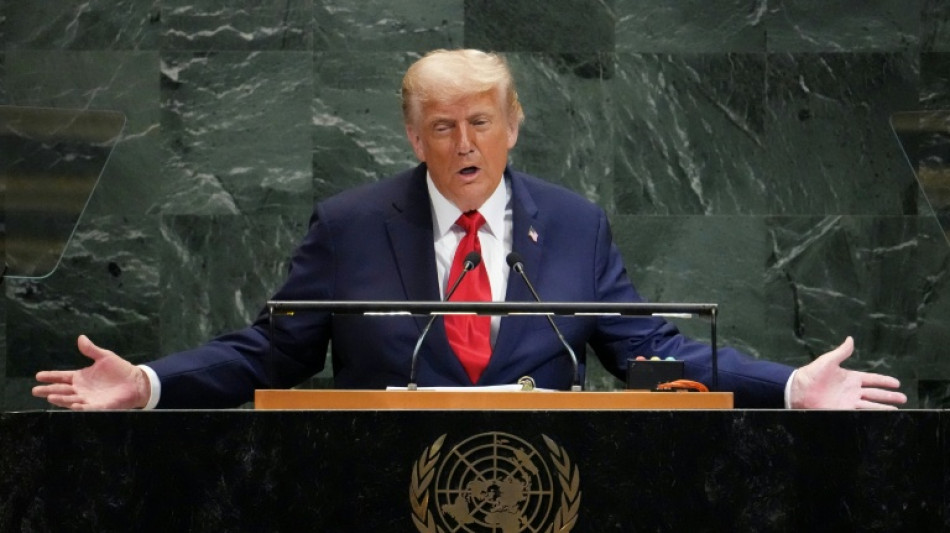
Speaking before the General Assembly in September, Trump delivered a scathing broadside against the world body founded in 1945 to promote global peace and cooperation in the wake of the Second World War.
"What is the purpose of the United Nations?" asked Trump in a wide-ranging speech, whose litany of complaints extended even to a broken escalator and teleprompter at the UN's New York headquarters.
W.Murphy--NG