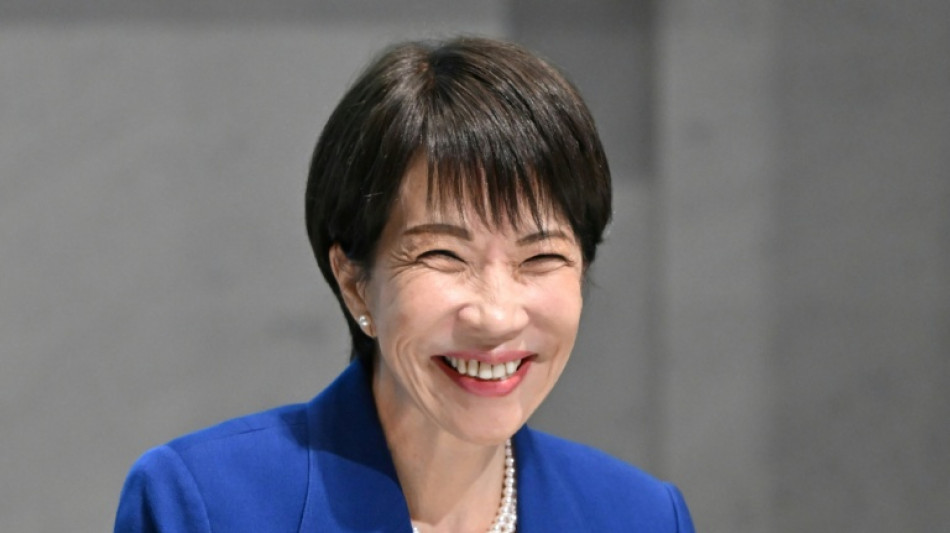
Japanese women MPs want more seats, the porcelain kind / Photo: Kazuhiro NOGI - AFP/File
Nearly 60 women lawmakers in Japan, including Prime Minister Sanae Takaichi, have submitted a petition calling for more toilets in the parliament building to match their improved representation.
Although the number of women politicians rose at the last election -- and despite Takaichi becoming the first female prime minister in October -- Japanese politics remains massively male-dominated.
This is reflected by there being only one lavatory containing two cubicles for the lower house's 73 women to use near the Diet's main plenary session hall in central Tokyo.
"Before plenary sessions start, truly so many women lawmakers have to form long queues in front of the restroom," said Yasuko Komiyama from the opposition Constitutional Democratic Party.
She was speaking after submitting the cross-party petition signed by 58 women to Yasukazu Hamada, the chair of the lower house committee on rules and administration, earlier this month.
The Diet building was finished in 1936, nearly a decade before women got the vote in December 1945 following Japan's defeat in World War II.
The entire lower house building has 12 men's toilets with 67 stalls and nine women's facilities with a total of 22 cubicles, according to the Yomiuri Shimbun newspaper.
Gender-rigid Japan ranked 118 out of 148 this year in the World Economic Forum's Global Gender Gap Report. Women are also grossly under-represented in business and the media.
In elections, women candidates say that they often have to deal with sexist jibes, including being told that they should be at home looking after children.
Currently, 72 of 465 lower house lawmakers are women, up from 45 in the previous parliament, as are 74 of the 248 upper house members.
The government's stated target is to have women occupy at least 30 percent of the legislative seats.
Takaichi, an admirer of former British premier Margaret Thatcher, said before becoming premier that she wanted "Nordic" levels of gender balance in her cabinet.
But, in the end, she appointed just two other women to her 19-strong cabinet.
Takaichi, 64, has said she hopes to raise awareness about women's health struggles and has spoken candidly about her own experience with menopause.
But she is still seen as socially conservative.
She opposes revising a 19th-century law requiring married couples to share the same surname, and wants the imperial family to retain male-only succession.
The increasing demand for female loos can be seen as a sign of progress for Japan although it also reflects the nation's failure to achieve gender equality, Komiyama said.
"In a way, this symbolises how the number of female lawmakers has increased," Komiyama told reporters, according to her party's website, adding that she hoped for more equality in other areas of life.
K.Cairstiona--NG