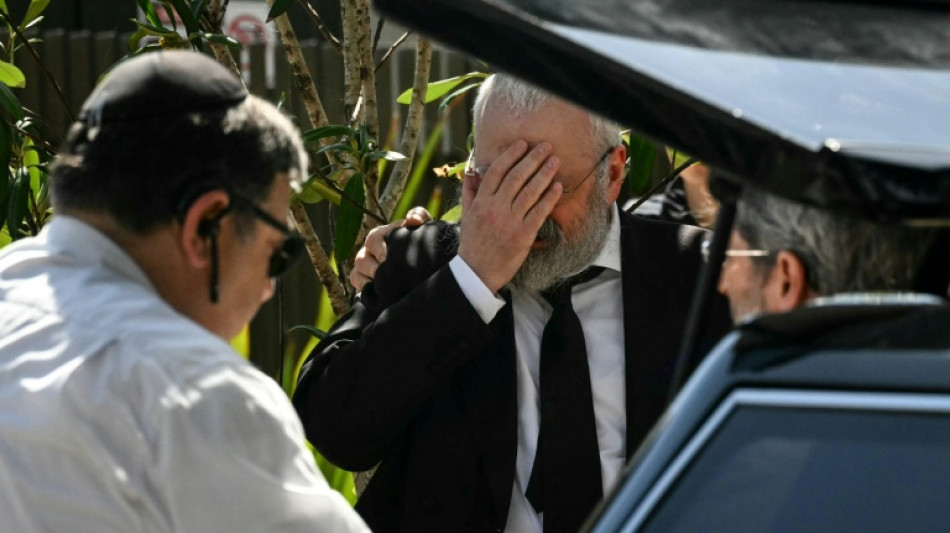
Australia holds first funeral for Bondi Beach attack victims / Photo: Saeed KHAN - AFP
Australia held the first funeral Wednesday for victims of the Bondi Beach mass shooting, as large crowds gathered to grieve a rabbi slain in the attack.
Sajid Akram and his son Naveed opened fire on a Jewish festival at the famed surf beach on Sunday evening, killing 15 people and wounding dozens more.
Among the victims were a 10-year-old girl, two Holocaust survivors, and a married couple shot dead as they tried to thwart the attack.
Father-of-five Eli Schlanger, known as the "Bondi rabbi", was the first person mourned with a service at Chabad of Bondi Synagogue.
Schlanger was a chaplain who served in prisons and hospitals, according to the Chabad movement, which represents a branch of Hasidic Jews and organised Sunday's event.
Mourners cried as his body was wheeled into the synagogue inside a black coffin.
Two young women wailed with grief as they draped themselves over the casket.
"Anyone who knew him knew that he was the very best of us," said Jewish community leader Alex Ryvchin before the funeral.
The Chabad of Bondi Synagogue will hold a second funeral for 39-year-old rabbi Yaakov Levitan in the afternoon.
Levitan was a father of four renowned for his charitable work, the Chabad movement said.
Squads of police patrolled the streets outside the Bondi synagogue, marshalling the large crowds gathered to pay their respects.
"My heart goes out to the community today and every day," Prime Minister Anthony Albanese said on Wednesday.
"But today particularly will be a difficult day with the first funerals underway," he told a local radio station.
- Sowing panic -
Authorities said the attack was designed to sow panic among the nation's Jews.
Albanese said the father-and-son gunmen had been radicalised by an "ideology of hate".
"It would appear that this was motivated by Islamic State ideology," he told national broadcaster ABC on Tuesday.
Questions are mounting over whether authorities could have acted earlier to foil the attack.
Naveed Akram, reportedly an unemployed bricklayer, came to the attention of Australia's intelligence agency in 2019.
But he was not considered to be an imminent threat at the time and largely fell off the radar.
Police are investigating whether the pair met with Islamist extremists in a visit to the Philippines weeks before the attack.
Manila's immigration department has confirmed to AFP that they spent almost all of November in the Philippines, with their final destination listed as Davao.
The region, on the southern island of Mindanao, has a long history of Islamist insurgencies.
Carrying long-barrelled guns, the duo fired upon the Bondi beachfront for 10 minutes before police shot and killed 50-year-old Sajid Akram.
Naveed Akram, 24, was also shot and remained in hospital under police guard.
He woke from a coma on Tuesday night, local media reported.
- 'Australian heroes' -
Recently surfaced dashcam footage showed married couple Boris and Sofia Gurman trying to thwart the attack in its earliest stages.
Retired mechanic Boris Gurman, 69, knocks one attacker to the ground as he tries to rip away his long-barrelled gun.
He briefly wrests control of Sajid Akram's weapon as his wife Sofia Gurman, 61, dashes towards him in support.
The assailant reportedly managed to get another gun, and the couple were shot and killed.
"While nothing can lessen the pain of losing Boris and Sofia, we feel an overwhelming sense of pride in their bravery and selflessness," the Gurman family said in a statement.
Australia's leaders have agreed to toughen laws that allowed father Sajid Akram to own six guns.
Mass shootings have been rare in Australia since a lone gunman killed 35 people in the tourist town of Port Arthur in 1996.
That attack sparked a world-leading crackdown that included a gun buyback scheme and limits on semi-automatic weapons.
But in recent years Australia has documented a steady rise in privately owned firearms.
The attack has also revived allegations that Australia is dragging its feet in the fight against antisemitism.
"I demand that Western governments do what is necessary to fight antisemitism and provide the required safety and security for Jewish communities worldwide," Israel's Prime Minister Benjamin Netanyahu said in a video address Tuesday.
"They would do well to heed our warnings," he added. "I demand action -- now."
O.Somerville--NG