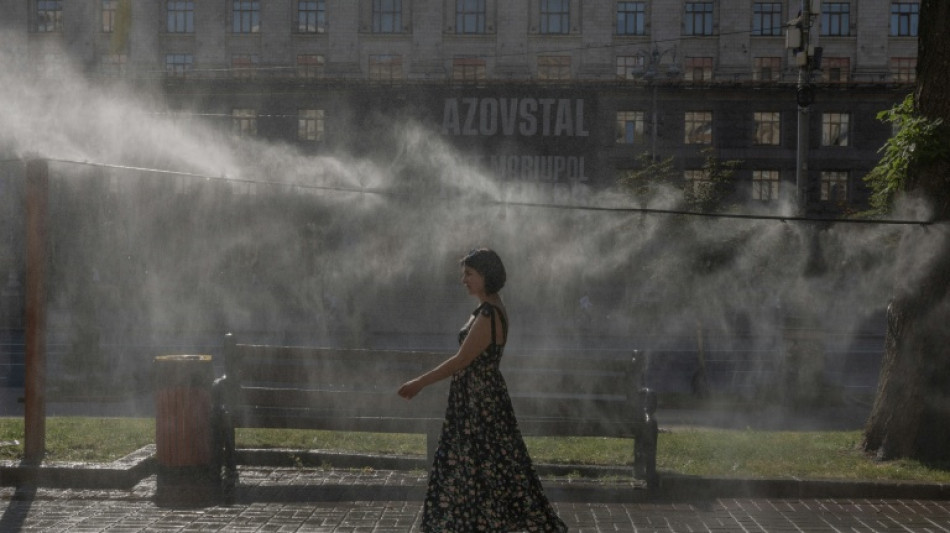
One for the history books: what we know about the European heatwave / Photo: Roman PILIPEY - AFP
Europe is still taking stock of a powerful heatwave in late June but experts are already confident it ranks among the worst ever recorded -- even rivalling a freak 2003 episode.
Temperature records were rewritten across Europe as hundreds of millions of people withered under extreme heat that closed schools, shut down transport and cost untold lives.
A heat dome trapped hot air from North Africa over the Iberian Peninsula in late June before spreading as far as the United Kingdom, eventually weakening over central and eastern parts of Europe in early July.
As the mercury starts to rise again in Europe, here's what we know so far about the impact of the early summer heatwave:
- Memories of 2003 -
As the June episode intensified, comparisons were quickly made to August 2003, when a heatwave of unprecedented magnitude baked Europe for a fortnight, causing tens of thousands of excess deaths.
Alvaro Silva, from the World Meteorological Organization, said duration was one measure of heatwave severity -- along with intensity and range -- and this recent episode was not as long as 2003.
"But we got many temperature records during this heatwave and the most impressive thing, we were still in June. So this is a big difference," the climate scientist told AFP.
France's weather service said the 14-day heatwave was even "more intense" than the 2003 episode that claimed 15,000 lives in France -- although it was two days shorter.
Meteo France said temperatures above 40C were registered 114 times between June 17 and June 29 -- surpassing the previous record of 87 instances during August 2003.
The UK Met Office said "direct comparisons with historic events are not straightforward because each heatwave has different characteristics".
The recent heatwave was "one of the most significant" the UK has experienced in recent decades and particularly notable for a combination of "sustained heat, exceptional humidity and very warm nights", it added.
- Severe, historic -
World Weather Attribution, a network of climate scientists, said the heatwave was the "most severe ever recorded" based on a three-day forecast of average peak temperatures over the region studied.
Such a heatwave would have been "virtually impossible" without the influence of climate change, they said. A similar event in June 2003 would have been about 2C cooler.
In a preliminary assessment, Germany's weather service said the heatwave "can without a doubt be described as historic".
"Since weather records began, there has never before been such a long and intense heatwave so early in the summer, in Germany or in many other parts of Europe," it said.
Radim Tolasz, a climatologist at the Czech Hydrometeorological Institute, told AFP the heatwave smashed previous temperature highs and for June was the longest ever recorded.
In the Netherlands it was only the sixth most severe on record.
- 35C for 2/3rds of Europeans -
More than two-thirds of Europeans endured temperatures topping 35C during the June 15-30 heatwave, according to an AFP analysis.
Areas inhabited by some 410 million people on the continent were concerned by the hot spell, compared with 320 million during the record-setting heatwave of August 2003.
Almost the entire population of mainland France and more than three-quarters of the combined populations of Spain and Italy experienced temperatures exceeding 35C at some point in June.
- Death toll -
The heatwave has been linked to thousands of excess deaths in Europe.
France recorded a 29.1 percent increase in the number of recorded deaths during the week starting June 22. That corresponded to 2,025 additional deaths compared to the previous week.
In Spain, at least 1,028 people died of heat-related issues in June, more than double the figure from the same month last year.
Belgium reported 39 percent more deaths than normal between June 18 and 29, amounting to 1,222 excess fatalities.
In the Netherlands, provisional estimates of mortality figures for June 22-28 indicated approximately 480 more deaths than expected.
- Temperature records -
Temperature records tumbled across Europe, with the thermostat topping 40C in many locations during the hot spell.
Germany, Poland, Slovakia, the Czech Republic and Hungary recorded their hottest ever temperatures, while the United Kingdom, France and Switzerland hit new highs for June.
np-lt-burs/ach
W.Murphy--NG