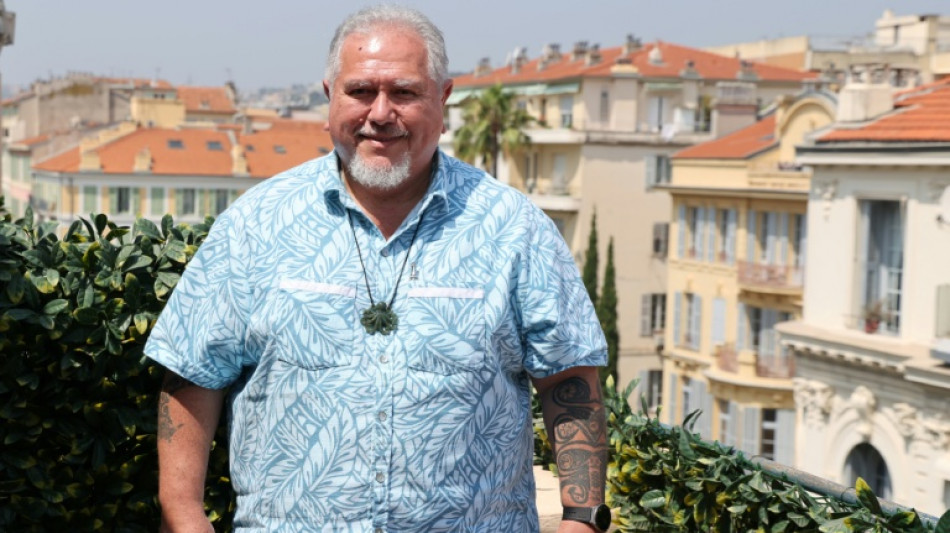
'Our mission as Oceanians': French Polynesia to protect more ocean / Photo: Ludovic MARIN - AFP
French Polynesia has announced it will expand the size of its fully shielded natural reserves inside what is already the world's largest marine protected area in the far South Pacific.
The overseas territory of France, since last year, has a vast area of almost five million square kilometres (1.93 million square miles) that is protected.
It will now increase the area where any human activity is totally forbidden from 1.1 to 1.6 million square kilometres.
"This is our mission as Oceanians," Moetai Brotherson, president of the archipelago, told AFP.
"We also hope that it can inspire other countries, especially the larger ones, in the way they manage their relationship with the ocean."
The existing 1.1 million square kilometres of fully protected waters are called "no-take zones, where only sustainable tourism activities and certain traditional fishing activities may be authorised", he said.
These areas -- where commercial fishing is banned -- include a 680,000-square-kilometre marine park in the Gambier Islands, which, together with the neighbouring Pitcairn reserve, forms the world's largest strictly protected transboundary area, and another near the Society Islands.
A smaller part is made up of coastal waters where small boats are allowed limited fishing.
"We are going to add two new marine protected areas: one to the northeast of the Marquesas Islands and the second to the south of the Austral Islands," Brotherson said.
He urged more state funding to help protect the ocean, as well as more navy patrols of the area.
In recent months, the French navy has focused its resources on fighting drug trafficking, capturing several tonnes of drugs and dumping them at sea.
The navy says it does this outside French waters, but many French Polynesians have criticised the practice.
"It might be better to destroy these drugs in a way other than throwing it into the ocean," Brotherson said.
Another point of friction with France concerns so-called "fish aggregation devices", cheap makeshift rafts equipped with a GPS that boats drop outside French Polynesian waters.
They attract fish, which these foreign fishing vessels then haul in as soon as they leave French waters.
French law bans their use but not having them on board a boat, which Brotherson said was "a point of disagreement with the state".
Deep-sea mining is banned in French Polynesia, as it is in Palau, Fiji, Vanuatu and Samoa.
M.Sullivanv--NG