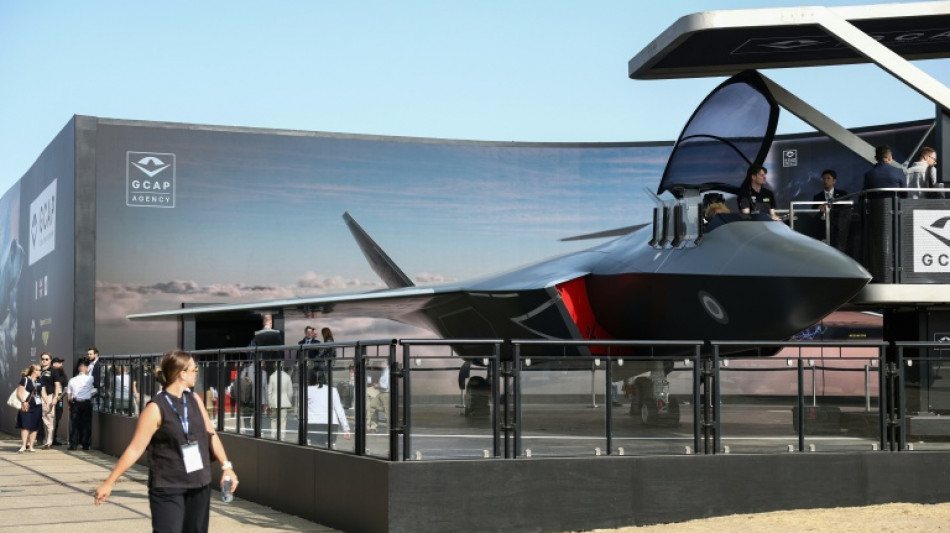
Britain's Burnham says open to Germany joining warplane project / Photo: Toby Shepheard - AFP
British Prime Minister Andy Burnham said Thursday that he was open to having Germany join a next-generation fighter jet project, after the collapse of a Franco-German warplane programme.
Britain, Italy and Japan are working on the "Global Combat Air Programme" (GCAP), which aims to replace the Eurofighter Typhoon and Mitsubishi F-2 jets currently used by those countries.
Germany's competing next-generation fighter jet project with France and Spain -- the "Future Combat Air System" (FCAS) -- fell apart in June amid bickering between the companies involved.
During a visit to Berlin, Burnham said he had told Chancellor Friedrich Merz about Britain's "openness to Germany joining GCAP" during discussions earlier in the day.
Burnham said he hoped to work with Italy and Japan "in the coming period" on having them join as well.
Merz, standing alongside Burnham, did not comment on the issue.
The FCAS project foundered after French aerospace group Dassault demanded greater control over the initiative, a push that ruffled feathers in Berlin and at the defence branch of Airbus, which is based in Germany.
Both France and Germany had prioritised keeping local industry involved in cutting-edge defence projects as part of the programme.
That could pose an obstacle for adding Germany to the GCAP programme, since major firms in all three countries such as BAE Systems, Leonardo and Mitsubishi have already divided up much of the work.
Swedish aerospace firm Saab has also been mentioned as a potential partner for Germany and Airbus in building a next-generation fighter.
French and German officials have publicly maintained that other parts of the FCAS project, such as networked combat computer systems and a swarm of drones that would accompany the fighter, will continue.
And an eight-company consortium including Airbus has pitched Berlin on building the next-generation jet themselves, in place of FCAS.
bst/sr/js
W.Murphy--NG