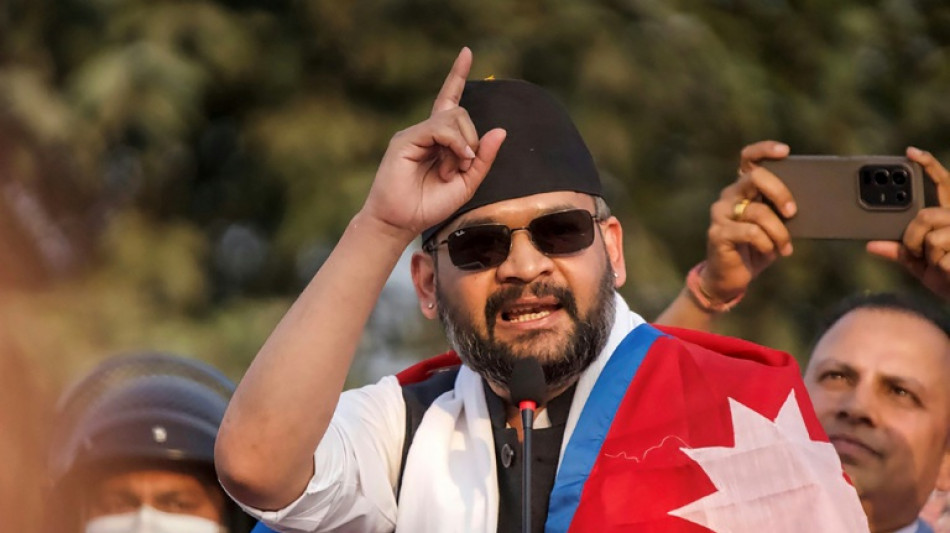
Rapper-turned-PM faces first big test after Nepal disaster / Photo: Sumit MISHRA - AFP/File
Nepal's rapper-turned-prime minister swept to power six months ago on a wave of youth-led anti-corruption protests, buoyed by optimism for change.
Now Balendra Shah faces his biggest test as his country's leader after a catastrophic flood on the China-Nepal border killed more than 1,400 people and left thousands missing.
The disaster has pushed climate diplomacy to the centre of the 36-year-old's premiership, overshadowing the anti-corruption agenda that powered his rise to office.
Shah is due to address the United Nations General Assembly this week, using his first foreign trip as prime minister to press Nepal's case for greater international support to recover from a disaster scientists have linked to climate change.
Shah has called the "unimaginable and heartbreaking" flood "not an ordinary" event, warning that it demonstrates the growing dangers facing communities across the Himalayas.
"It is now time for us to strongly raise with the international community the issue of the disasters we are experiencing as a result of climate change," he said, after visiting affected areas last month.
The tsunami-like floodwaters tore through mountain districts, destroying roads, bridges and hydropower projects while killing at least 1,494 people in Nepal and China's Tibet region. More than 6,000 people remain missing.
Shah has warned the disaster shows "that the risks we face in the Himalayan region are increasing alongside climate change."
Nepal, a country of around 30 million people that contributes only a fraction of global greenhouse-gas emissions, estimates reconstruction will cost $4.78 billion.
Better known as Balen, the ex-music star -- often seen in a sharp black suit and sunglasses -- celebrated his March election victory with a song declaring that "unity is my national power".
He unseated veteran Marxist leader and four-time prime minister KP Sharma Oli in his own constituency, with the centrist Rastriya Swatantra Party (RSP) winning a landslide parliamentary majority.
His rise capped a rapid political ascent that began with an upset victory as Kathmandu mayor in 2022.
- 'No greater pain' -
Born in Kathmandu in 1990, he was a schoolboy during Nepal's 1996-2006 Maoist civil war, which killed thousands and eventually ended the monarchy.
A civil engineer by training, he first gained national attention through Nepal's underground hip-hop scene, using his songs to rail against corruption and inequality.
His music drew millions of views online and helped him build a devoted following on social media -- a platform he continues to favour over traditional outlets for communicating with supporters.
That popularity translated into a political shock in 2022, when Shah became the first independent candidate elected mayor of Kathmandu, stunning Nepal's entrenched political establishment.
As mayor, he built a reputation as a blunt and often confrontational reformer through campaigns targeting tax evasion, traffic congestion and mismanagement.
But his tenure also attracted criticism for heavy-handed tactics and for bypassing journalists in favour of broadcasting directly to followers.
Shah emerged as a central figure during the anti-corruption protests that swept Nepal in September 2025.
Initially sparked by youth anger over a brief ban on social media platforms, the demonstrations escalated into a broader movement against corruption and economic stagnation.
The unrest quickly spread nationwide. Parliament and government offices were set ablaze, and Oli's government collapsed.
More than 70 people were killed during the unrest.
"Gen Z's number one demand is good governance, because there is a high level of corruption in the country," Shah said while campaigning earlier this year.
He described a vision of "a liberal economic system with social justice", including free education and healthcare for the poor.
The flood disaster has put a new and unexpected burden on a leader who built his political career on promises to shake up Nepal's establishment and deliver better governance -- forcing climate change to the centre of the national agenda.
"There can be no greater pain than losing loved ones, homes and livelihoods," he said.
O.Somerville--NG