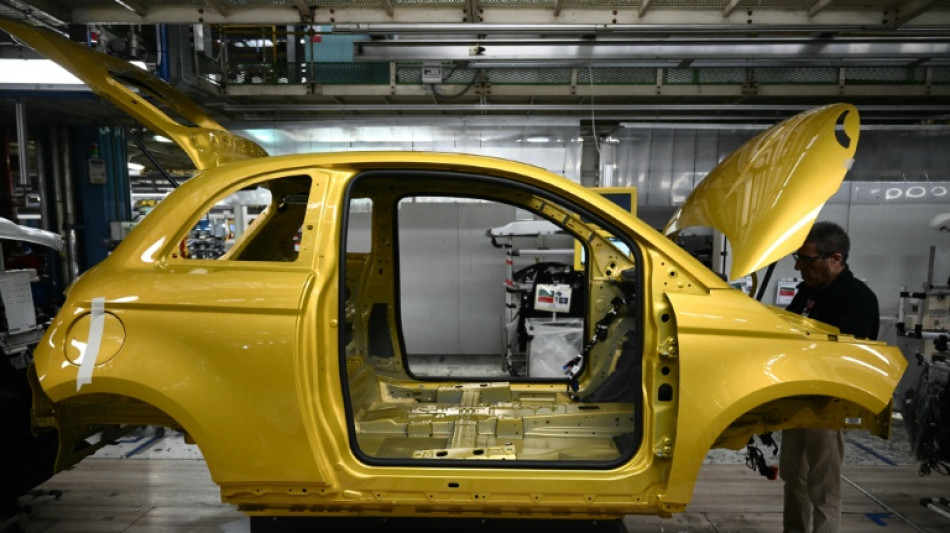
EU chief backs Made-in-Europe push for 'strategic' sectors / Photo: MARCO BERTORELLO - AFP/File
EU chief Ursula von der Leyen on Monday backed a push to favour European firms over foreign rivals in "strategic" fields, ahead of a leaders' meeting on boosting the bloc's competitiveness.
The EU executive will put forward a proposal later this monthto prioritise European companies in public procurement for key sectors, but the move faces pushback from some member states and partners.
In a letter to the bloc's leaders, von der Leyen argued Europe must be able both to "defend its strategic interests" and support home-grown production.
"A European preference is a necessary instrument that contributes to this objective," she wrote, arguing such a move would "help create lead markets in strategic sectors".
In a draft seen by AFP, the EU executive wants rules that would force companies bidding for public contracts in sectors such as cars and green technology to prove that a certain percentage of their products are made in Europe.
The European Commission has twice delayed its proposal because of fierce internal debates, with some seeking to dilute its scope.
In her letter to leaders, von der Leyen said any European preference "must be underpinned by robust economic analysis and aligned with our industrial priorities, while engaging constructively with trusted partners".
- Worries overseas -
EU industry chief Stephane Sejourne has argued it is time for Europe to have its own version of the "Buy American Act" and "Made in China" to protect firms.
In an op-ed published this month and signed by more than 1,100 CEOs and business leaders, Sejourne said that "whenever European public money is used, it must contribute to European production and jobs".
The "Made in Europe" concept has been popular in France for years and Paris has been seeking tough limitations on defence purchases from outside the EU.
But France's enthusiasm has been met with scepticism from some EU partners.
"They always say 'European', but they think everyone is going to buy French things, so there's still a lot of work to be done," Belgian Prime Minister Bart De Wever told national broadcasters.
There have also been concerns further afield.
Turkish President Recep Tayyip Erdogan wrote a letter to von der Leyen seen by AFP in December in which he warned of the unwanted consequences of such moves for Turkey, which is in a customs union with the bloc.
In particular, Erdogan raised concerns about the impact on the automobile sector, a sentiment echoed by Japanese companies in public and private.
Japanese carmaker Honda urged Brussels to extend the concept to "Made with Common Values", warning that "overly restrictive local content requirements will not necessarily shore up European manufacturing" because of the industry's global nature.
- 'Limited' measures -
Italy and Germany last month offered lukewarm support for the "Made in Europe" idea, cautioning against going too far.
"To protect our interests, this might include making use of EU-preference rules in crucial and core strategic sectors, while taking due account of our trade policy interests and of likeminded partners," Berlin and Rome said.
And last week six member states -- Estonia, Finland, Latvia, Lithuania, the Netherlands and Sweden -- warned that such rules could "risk adding another layer of complex regulation", in a document seen by AFP.
They did not wholly reject the idea but said the measures should be "limited, proportionate and based on a clear understanding of the consequences".
The commission's point of reference is former European Central Bank chief Mario Draghi's landmark 2024 report on the EU economy.
In the report, Draghi advocated for a European preference in defence procurement and in the space sector, albeit in a targeted manner.
D.R.Megahan--NG