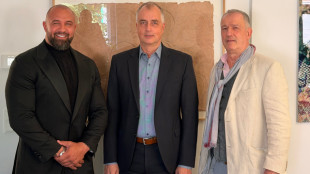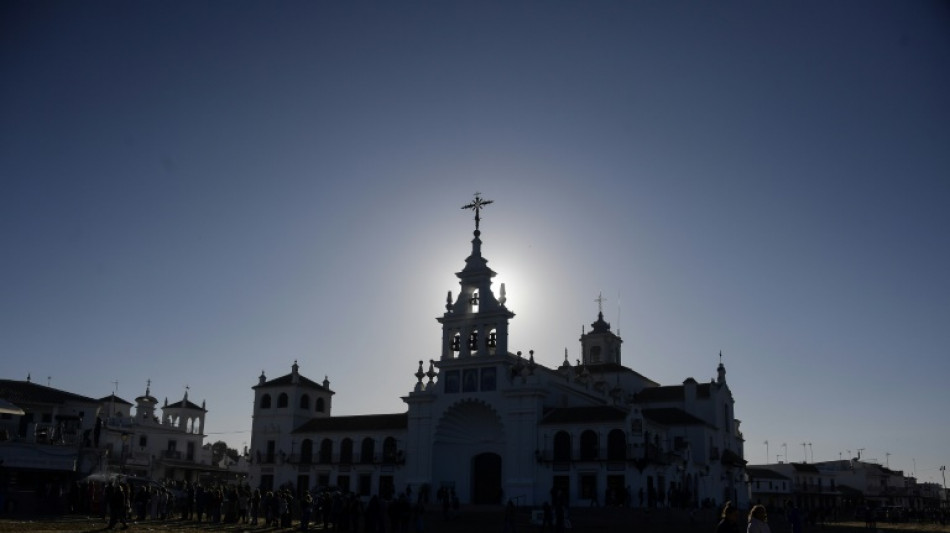
Spain signs agreement with Church to compensate abuse victims / Photo: CRISTINA QUICLER - AFP/File
The Spanish government and the Catholic Church signed a landmark agreement Thursday to compensate victims of sexual abuse by clergy, aiming to settle what officials described as a "moral debt".
The accord signed by Justice Minister Felix Bolanos and the Spanish Episcopal Conference (CEE) sets up a system to provide reparations to victims of church-related sexual abuse who are unable to pursue legal action because the crimes have proscribed or the victim has died, the justice ministry said in a statement.
"For decades there has been silence, concealment, a moral harm often impossible to repair," Bolanos told a news conference.
"This agreement allows us to settle a historical moral debt we owed to the victims of abuse."
Victims' associations, which have long accused the Church of stonewalling, welcomed the accord.
"This is something we have been fighting for over many years," Juan Cuatrecasas, a spokesperson for the Infancia Robada (Stolen Childhood) association, told AFP.
"It is also very important to us that the Church, even if under pressure from the Vatican, is now committing to provide reparations," added Cuatrecasas, whose son was sexually abuses as a minor by a teacher at a Catholic school.
- 'Moral commitment' -
Under the new system, the Church will fund the reparations -- a first in Spain, where ecclesiastical authorities had previously resisted participating in such programs.
Luis Arguello, president of the CEE, called the agreement "another step along the path we have been pursuing for years", noting that the Church already had internal mechanisms to compensate victims.
Victims will submit complaints to the state ombudsman's office, which will propose reparations that may include financial, moral, psychological, restorative, or combined measures, Bolanos said.
If either the victim or the Church rejects the proposal, a mixed commission of representatives from the Church, the government, and victims will review it.
Failing an agreement at that stage, the ombudsman's recommendation will prevail.
The window for filing claims will be open for one year, with the option of extending it for an additional year if needed.
The Spanish Bishops’ Conference (CEE) said in a statement the agreement "is not based on the imposition of a legal obligation, but on the Church’s moral commitment".
It also welcomed the government’s pledge "to address comprehensive reparations for victims of abuse in all areas of social life", a long-standing demand of the Church, which has argued that the focus should not fall solely on it.
Bolanos credited the Vatican with providing "a necessary and essential impetus" for the deal, which he had previously discussed with the late Pope Francis and Vatican Secretary of State Pietro Parolin.
- Over 200,000 victims -
The accord follows a 2023 report by Spain's ombudsman which found that more than 200,000 minors had suffered sexual abuse by Roman Catholic clergy since 1940.
That number could rise to 400,000 if abuse by laypersons in religious settings is included.
Church leaders initially rejected the findings, and argued that many more people had been abused outside of the church.
The Church's own records list 1,057 "registered cases", with 358 deemed "proven" or "credible".
The agreement comes as Pope Leo XIV is poised to visit Spain in June, the Archbishop of Madrid, Jose Cobo, told Cope radio, which is owned by the Spanish Episcopal Conference, last month.
Unlike in other nations, in Spain -- a traditionally Catholic country that has become highly secular -- clerical abuse allegations only recently started to gain traction, thanks mainly to media reporting on the issue.
Church efforts to compensate abuse victims have long been inconsistent, with programs and payouts varying widely around the world.
In the United States, where the crisis first surfaced in 2002, legal claims and compensation schemes have cost the church billions, forcing some dioceses to seek bankruptcy protection.
O.Ratchford--NG