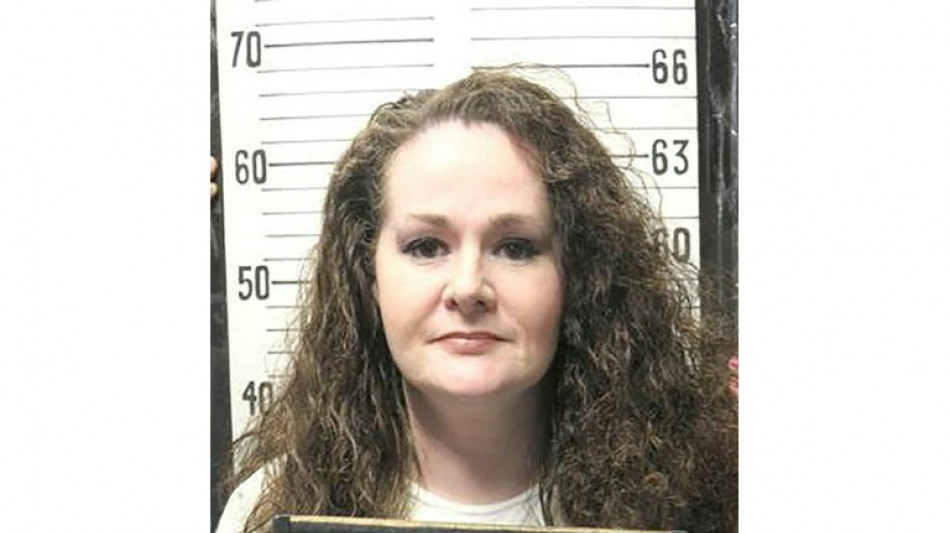
Botched US execution prompts global calls to scrap death penalty / Photo: Handout - Tennessee Department of Correction/AFP
An unprecedented botched execution that left a female murderer alive after two lethal injections triggered international calls Thursday for the US state of Tennessee to abandon capital punishment.
Christa Pike, 50, was taken to a hospital after the failed attempts to put her to death on Wednesday night. Her condition Thursday was not known, and Tennessee officials have not said how she survived the deadly doses of pentobarbital.
"This event is the worst we've seen and unlike any other botched execution in the modern era," Robin Maher, the executive director of the Death Penalty Information Center, told The New York Times. "There is no precedent."
UN rights chief Volker Turk on Thursday urged Tennessee not to make a new attempt to execute Pike.
"The case of Christa Pike lays bare multiple reasons why the death penalty should be abolished," his office said on X.
"The prolonged suffering -- physical and mental -- arising from multiple failed execution attempts is abhorrent, and cruel. And there are key fair trial questions still unresolved."
Pike's lawyers said in a statement that their arguments against the execution had come to pass: "difficult vein access, blown veins, degraded pentobarbital, no emergency medical care available when things inevitably go wrong, all under a protocol that remains veiled in secrecy."
- 'Loudly snoring' -
Pike's case had already attracted scrutiny in the lead-up to her execution date, as she would have been the first woman put to death in Tennessee in more than 200 years.
Kim Chandler, a media witness with The Associated Press, told CBS News that "Pike appeared notably awake as the execution began" at Riverbend Maximum Security Institution in Nashville.
"A couple of times she looked around the room. At one point she looked towards prison officials and asked if it was supposed to feel that way," Chandler said.
Pike later began snoring, witnesses said.
"We just listened... to her snoring and making very loud breathing sounds for almost an hour," said Catherine Sweeney of WPLN television.
The condemned woman was "loudly snoring, clearly very alive" as the journalists were ushered out of the area, Chandler told CBS.
During a livestream, an ambulance with its lights flashing could be seen leaving the prison. It was unclear if it was transporting Pike.
- Established protocol -
The Tennessee Department of Correction said it "followed every step of the state's lawful, established execution protocol," adding that Pike was subsequently taken to an "off-site medical facility."
Governor Bill Lee called for a "comprehensive, third-party review" after Pike's failed execution.
"The remaining scheduled execution will not be carried out this year," Lee said -- apparently referencing the execution of convicted killer Gary Wayne Sutton scheduled for December 3.
Pike's case had sparked debate over capital punishment for young criminals. She was 18 when she and her boyfriend beat and killed Colleen Slemmer, 19, at a job training camp for young people.
The killing gained national attention after Slemmer's body was found with a pentagram, often seen as a satanic symbol, carved in her chest.
Following a flurry of legal filings by Pike's lawyers that delayed the start of the execution by several hours, the US Supreme Court on Wednesday night cleared the way for the punishment to go ahead.
Pike's lawyers had argued she should be granted clemency due to her young age and mental health issues at the time of the killing.
They said her history of childhood sexual assault, post-traumatic stress disorder and a blood condition meant a lethal injection would cause "needless suffering."
In the United States, only 18 women have been executed since 1976, according to the Death Penalty Information Center.
P.Connor--NG