Lucid Gravity 2026: Test report
The new electric SUV from a US manufacturer combines the range of a saloon car with the elite space of a van. An extensive winter test covering 8,000 kilometres in Europe, in which pre-production vehicles travelled from the Munich development centre to the Arctic Circle, confirms this high and fulfilled claim. The development team examined both performance on unlimited motorway sections and charging at three-phase European AC connections and state-of-the-art fast charging stations. In extreme cold and summer heat, the interaction of drive, charging performance and comfort was tested to meet the expectations of European customers.
Design and space
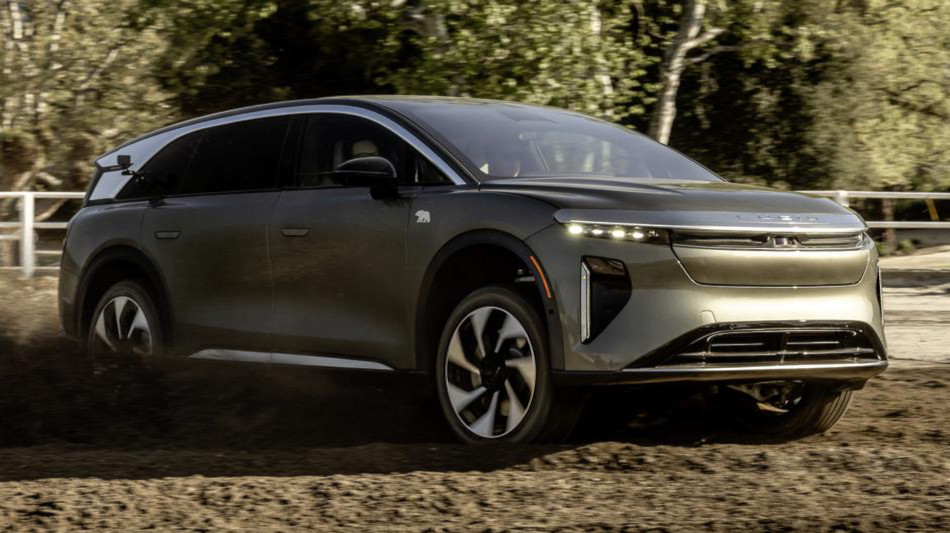
With a length of around 5.03 metres, a wheelbase of over 3.3 metres and a drag coefficient of 0.24, the SUV is surprisingly aerodynamic despite its imposing dimensions. The flat silhouette and flush-mounted door handles emphasise its elegant appearance. The raised windscreen extends seamlessly over the passengers' heads and, together with the panoramic glass roof, creates an airy feeling of space. Depending on the configuration, the vehicle can seat five to seven adults. The second row of seats can be folded electrically into the floor; individual seats will also be available in future. An additional storage compartment under the front bonnet – known as the frunk – has a capacity of 227 litres and can be converted into a bench seat thanks to upholstery. When the rear seats are folded down, the load volume increases to up to 3,450 litres.
Drive, battery and performance
The SUV uses a modular electric architecture with all-wheel drive and two electric motors. In the basic Touring version, the system delivers 418 kW (568 hp) and accelerates to 100 km/h in 4.2 seconds. The range of the Touring variant is up to 545 kilometres according to WLTP. The more powerful Grand Touring version delivers 617 kW (839 hp), sprints from 0 to 100 km/h in 3.6 seconds and achieves a range of up to 748 kilometres. An extreme torque of 1,232 Newton metres is available right from the start, which corresponds to the acceleration of a sports car. With a top speed of 270 km/h, the SUV sets new standards for electric family vehicles.
At the heart of the drive system is a 123 kWh battery with 926 volt technology. This voltage enables charging capacities of up to 400 kW. Depending on the charging station, a range of 400 kilometres can be recharged in around a quarter of an hour. At 500-volt charging points, 225 kW is permanently available. The vehicle supports bidirectional charging, meaning it can also feed energy back into the grid or to external devices. The European test fleet also used the large number of three-phase AC connections to optimise the everyday usability of the charging system.
Driving performance and comfort
Despite its heavy weight of just under three tonnes, the SUV is surprisingly agile. Adaptive air suspension and optional rear-axle steering ensure high driving stability on long motorway journeys and precise handling on country roads. Three driving modes (‘Smooth’, “Swift” and ‘Sprint’) allow you to switch between a comfortable glider and a performance SUV. The acceleration pushes passengers noticeably into their seats, but the suspension confidently irons out any bumps. The manufacturer even considers the model to be off-road capable; thanks to the air suspension, the ground clearance can be increased to such an extent that it rivals that of an iconic off-road vehicle. In practice, however, the SUV will mainly be used on paved roads.
Interior, infotainment and equipment
The cockpit is dominated by a 24-inch 6k OLED display that floats above the dashboard as a continuous panel. Below it is a second Full HD display for important functions. Both screens can interact and, during charging, show an animated surf reminiscent of the sound of the sea. Operation is almost exclusively via touch surfaces; even the mirror and glove compartment controls have been digitised. Haptic touch controls on the square steering wheel support menu navigation, while voice control with the command ‘Hey Lucid’ offers additional operating options.
Standard equipment includes four-zone climate control, ambient lighting, massage and ventilated front seats, and a Dolby Atmos sound system with 22 speakers. There are five different colour and material themes to choose from, with a special focus on sustainable materials. Large storage compartments in the doors, a sliding centre tunnel and a deep glove compartment offer plenty of storage space. To sum up the equipment without exaggeration: luxury as far as the eye can see!
Safety and assistance systems
The manufacturer has equipped the SUV with modern driver assistance systems. An invisible ‘co-pilot’ assists with driving and parking, while a system called ‘HaloSecure’ monitors the surroundings and detects potential hazards. In addition, there are functions required by EU regulations, such as emergency braking and lane departure warning systems, intelligent speed assistance, reversing assistance, fatigue warning and tyre pressure monitoring. Official crash test results are not yet available, but a similar saloon from the manufacturer has already received the highest rating in safety tests.
Warranty and reliability
Customers receive a four-year or 80,000-kilometre vehicle warranty, the powertrain is covered for up to 160,000 kilometres and the high-voltage system for ten years. However, there is a lack of long-term experience because the manufacturer has only a few models on the market. There have been isolated recalls and software problems with the saloon; whether the new SUV will experience similar teething problems will only become apparent after the first deliveries.
Market launch and prices
Production of the Grand Touring variant began in Arizona in the United States at the end of 2024, with the Touring version following a year later. In Europe, the SUV has been available to order since autumn 2025; the first deliveries for Germany were also made in autumn 2025, and production is ongoing. Prices start at around £99,900 for the Touring variant, while the Grand Touring version is available from £116,900.
In the USA, the base model starts at around $79,900, while the higher-powered version costs from $94,900. A future entry-level model could further round off the price range below €100,000.
Conclusion on the new Gravity
The new electric SUV sets new standards with its powerful drive, record-breaking charging capacity and generous space. Winter testing in Europe shows that the vehicle performs extremely reliably even under extreme conditions and is adapted to the requirements of European roads and charging infrastructure. The combination of pure luxury, practical versatility and impressive performance makes the model a serious competitor for established premium manufacturers. However, high prices and a still sparse distribution network could severely limit its success, but its technical capabilities promise an exciting future for the electric SUV.